Wednesday, February 08, 2012

Government Can't Make Us Happy By John Stossel

Government Can't Make Us Happy

By John Stossel

In the Declaration of Independence, Thomas Jefferson called the pursuit of happiness an unalienable right. This was a radical idea. For most of history, most people didn't think much about pursuing happiness. They were too busy just trying to survive.

Then came the liberal revolution based on the idea of individual freedom. Only then did they start thinking that happiness might be possible on earth.

Unfortunately, somewhere along the way, the right to pursue happiness has been perverted into a government-backed entitlement to happiness.

British Prime Minister David Cameron says, "There's more to life than money. ... It's time we focus not just on GDP, but GWB -- general well-being."

Well-being sounds good. But is that something that government programs promote?

Philip Booth, an economist with London's Institute of Economic Affairs and editor of "... And the Pursuit of Happiness," says no. I spoke recently with Booth and economist Christopher Coyne of George Mason University, who contributed to that volume.

Since the country of Bhutan got all kinds of publicity by using a measure it calls "gross national happiness" instead of gross national product, and The New York Times says it's a "new measure of well-being from a happy little kingdom," I asked them if there is anything to it.

"It's not a model that most Western societies would want to copy," Booth said.

I didn't think so. In Bhutan, people can get locked up for criticizing the government. Yet one study ranked the United States 23rd in the list of happy places. Bhutan was higher on the list.

That's nonsense, said Coyne. It makes more sense to judge a country's ability to make its citizens happy by whether foreigners want to move there. Clearly, more people want to move to America than to Bhutan. "The way to think about this," Coyne said, "is the fact that so many people want to come to the United States indicates that they at least perceive there is the opportunity to pursue what makes them happy."

What does make people happy? People fantasize about leisure and luxury, but the best data show that such things don't create lasting happiness. What does make for happiness is obtaining work that allows you to move toward goals that you find meaningful. In other words, what's important is not just employment, but purposeful work. So is having control over your workplace. Chrysler found that if workers have more control on the assembly line, they are happier. The freedom to decide your own goals is crucial.

Other things that make people happy are religion, having family and friends you care about, giving to others (face to face or via charity) and money.

Actually, money makes you happier if you're miserably poor. But once you have a certain amount -- maybe enough that you no longer have to worry about your family's well-being -- more money doesn't make much difference. Lottery winners report that, a year after their windfall, they were no happier than they were before.

That's counter-intuitive. Instinct tells us that wealth brings happiness. It's a reason why some people envy the rich and why income inequality causes lots of angst today. One left-wing journalist writes, "Every model shows the most unequal societies are the least happy."

"There's no evidence that this is true," Coyne said. "Even the staunchest proponents of government intervention to increase happiness admit that there's no relationship."

You wouldn't know that reading The New York Times.

The mainstream media claim that the way to make people happy is to have government protect them from misfortune and give them stuff. The research doesn't bear that out, says Booth.

"In fact, the bigger government is, the less happy societies tend to be. There is a direct relationship, stripping everything else out, between the government allowing people more freedom and well-being increasing."

Yet politicians move in the other direction. The socialist likely to be France's next president wants to lower the retirement age from 62 to 60 and institute a "maximum-work" law.

When will they learn that you don't make people happier by taking their options away?

Saturday, February 04, 2012

Mas y Mas- Kinky

We've Figured Him Out - Ben Stein

Why is President Barack Obama in such a hurry to get his socialized medicine bill passed?

Because he and his cunning circle realize some basic truths:

The American people in their unimaginable kindness and trust voted for a pig in a poke in 2008. They wanted so much to believe Barack Obama was somehow better and different from other ultra-leftists that they simply took him on faith.

They ignored his anti-white writings in his books. They ignored his quiet acceptance of hysterical anti-American diatribes by his minister, Jeremiah Wright.

They ignored his refusal to explain years at a time of his life as a student. They ignored his ultra-left record as a "community organizer," Illinois state legislator, and Senator.

The American people ignored his total zero of an academic record as a student and teacher, his complete lack of scholarship when he was being touted as a scholar.

Now, the American people are starting to wake up to the truth. Barack Obama is a super likeable super leftist, not a fan of this country, way, way too cozy with the terrorist leaders in the Middle East, way beyond naïveté, all the way into active destruction of our interests and our allies and our future.

The American people have already awakened to the truth that the stimulus bill -- a great idea in theory -- was really an immense bribe to Democrat interest groups, and in no way an effort to help all Americans.

Now, Americans are waking up to the truth that ObamaCare basically means that every time you are sick or injured, you will have a clerk from the Department of Motor Vehicles telling your doctor what he can and cannot do.

The American people already know that Mr. Obama's plan to lower health costs while expanding coverage and bureaucracy is a myth, a promise of something that never was and never will be -- a bureaucracy lowering costs in a free society. Either the costs go up or the free society goes away.

These are perilous times. Mrs. Hillary Clinton, our Secretary of State, has given Iran the go-ahead to have nuclear weapons, an unqualified betrayal of the nation. Now, we face a devastating loss of freedom at home in health care. It will be joined by controls on our lives to "protect us" from global warming, itself largely a fraud if believed to be caused by man.

Mr. Obama knows Americans are getting wise and will stop him if he delays at all in taking away our freedoms.

There is his urgency and our opportunity. Once freedom is lost, America is lost. Wake up, beloved America.

Ben Stein is a writer, actor, economist, and lawyer living in Beverly Hills and Malibu. He writes "Ben Stein's Diary" for every issue of The American Spectator.

Friday, July 02, 2010

A Quiet Man


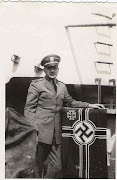
Standing on the brige of a German Sub captured by Commander Irvine's battle group.


A Quiet Man

My father was a quiet man.
He didn't speak of his adventures, he didn't brag of his triumphs.
My father was a graduate of the Naval Academy.
The Naval Academy at that time was one of the most difficult of schools to get into. It is by invitation only, only the best of the best. It was by congressional appointment to the sons of the best and brightest our country had to offer.
My grandfather was instrumental in the cure for syphilis during world war one.
Back then; it killed almost as men as the Germans. Therefore earning the placement for my father to attend the Naval Academy to pursue a engineering degree.

Now, after graduation my father was denied his commission as an officer because he wore glasses and at that time before our entrance to the war the armed forces could still be kind of picky who they wanted commanding their ships.
When my father was called to active duty, he was 24. he was to fight in World War II, as the commander of a destroyer in the north Atlantic.

The German submarines at that point had decimated allied shipping, navies and ruled the seas.
There was no radar, there was no sonar, and you knew a submarine was around when its first torpedo hit you or your colleague.
My father watched as ship after ship went down around him. He rescued all the men he could but he watched many others die; the surviving ships often turned and headed home, battered and beaten.

My father, his best friend, and a group of other ship captains came up with the combat convoy formation they still use today. One that would offer some protection to some of the ships and they went out yet again, to avenge with murderous intent.
The war was starting to turn by then, but the German navy still dominated the seas.
The Nazis decided to launch a huge winter offensive; they were counting on the weather, Mother Nature to assist them.
They were relying on weather reports from a submarine in the north Atlantic to launch and to facilitate their attack and victory.
Equipped with their new combat formation and our newest technology, a most basic radar and sonar my father detected the nazi sub.
For three days they hunted the sub, playing cat and mouse or "search and attack" off the coastline of Europe, then a sister ship reestablished contact with the new underwater sound equipment.
Commander James M. Irvine directed his ship into the field of fire and launched his depth charge attacks. The sinking of this sub was a key part in our victory in "The battle of the bulge", contributing materially to sealing our victory in WW2,
My father was awarded the Legion of Merit with the combat V, the third highest award of our navy.
The war for him was not over yet, on his last mission, he forced the surrender of another nazi sub, and escorted it back where it is on display in the Chicago museum of science and industry.
Dad never told me these stories, like a said he was a quiet man. I caught up with a young (back in WW2) man who had served under my father, he was kind enough to give me the picture above

My dad died July 4th weekend in 1988,
My son was 9 months old, and my father never saw his only grandson.
I was a different man back then. My ego, my pride, the anger of a young man had driven a wedge between my dad and I.
So we had not spoken for a while, July 4th weekend meant I was working. July 4th weekend meant nothing to me, except work and everybody complaining we had to work on a holiday. I liked the fireworks and the parties even though I worked through most of that too. But I never thought about the true sacrifice for freedom, his sacrifice for freedom, the ultimate sacrifice thousands have given.
My mother gave a call that weekend to let us know my father had died.
Mom gave me his medals, the letter from the President and Secretary of the Navy for his legion of merit, and the navies "action report".

As the years have passed I have grown, I have come to better understand my quiet father by reading those letters of award, by gazing at his medals, and the memories of a quiet man who sacrificed along with the tens of thousands before and since. The tens of thousands who paid the ultimate price for our freedom that I so carelessly enjoy.

The fourth of July is a day of parades, fireworks and celebration in the United States.
Someone in your family, or the family of someone you know are grieving for every freedom we enjoy.

Please share a moment of remembrance for the cost of our freedom.


Saturday, December 12, 2009

Tuesday, December 08, 2009

Hero: Gy Sgt. Ralph Scott


Ralph Scott

Like hail during a thunderstorm, the bullets landed all around the Marine as he simultaneously fired two M-16 service rifles, one in each arm. Staff Sgt Ralph Scott was using his own weapon and the weapon of his platoon sergeant, who was busy carrying another wounded Marine on his back to safety. Both rifles continuously erupted as he methodically emptied magazine after magazine into the insurgent position.

It was November 12, 2004, and Scott was in the middle of his seventh deployment. He was the platoon commander for the 1st Platoon Company C, Battalion Landing Team 1/3.

On this particular day, Marines Sgt Jack Foster and LCpl Robert Carter were pinned down in an open field in Fallujah, Iraq, with no cover. Foster had gone to get Carter, who had been hit in the arm and was severely wounded.

Soon Foster ran out of bullets. That’s when Scott, along with his platoon sergeant Sgt Michael Chambers and Cpl Jason Bennett ran into the open field to retrieve them.

“Bennett and I stood up in the field to draw the enemy fire to give the others a chance to run for a covered position into of a school house full of Iraqi Army soldiers,” Scott said. “In order to help Chambers lighten his load, I took his rifle and used it with mine. That is how I came to have two rifles to fire at the enemy.”

It was later called a miracle that any of them survived, especially considering that two rocket-propelled grenades had also been fired upon them, the shrapnel going every which way but inexplicably missing their flesh.

“Anybody from that platoon, seeing what he did,” started Chambers, “My words can’t do him justice.”

Scott, who has served in the Marine Corps since enlisting at age 17 in 1989, earned a Bronze Star Medal with Valor for his actions that day and other combat he saw between November and December of 2004.

He is a man with an unyielding sense of duty toward his fellow Marines, according to Chambers.

“When Staff Sergeant Scott first came to us in Charlie Company, all he said to us was, ‘My whole entire job — I don’t care if it takes my life — is to bring you all home,’” said Chambers. “I’m here to tell you that he stood behind his word.”

“All I can say is you won’t meet another man like him,” Chambers said. “Every battle we were in, while Marines would naturally and instinctively hit the deck when the first barrage would hit, Staff Sergeant Scott would be there standing, already simultaneously returning fire. We would follow his lead. There’s no finer man, no fiercer warrior that the Marines have ever sent into battle than that man. I would go back to combat with him in a second.”

“In my heart, I’m still with Charlie Company,” said Scott. “Whatever job the Marine Corps gives me, I will do it to the best of my ability, but I’d be lying if I said I’d rather be here than back with the grunts.”

“I wake up every morning, and I come to work,” said Scott. “Whether work happens to be behind a desk in Hawaii or on a battlefield in Iraq isn’t really the point. The point is to do your best and give your best effort at all times and in all situations.”

Friday, October 30, 2009

Hero: Navy HM2 Joshua Simson

In 2007, Navy HM2 Joshua Simson was embedded with a joint U.S. military and Afghan National Army patrol to conduct key leader engagements in the village of Saret Kholet. Simson was serving as an advisor on how to be a medical first responder.

On July 27, Simson demonstrated what committed first responders do when he repeatedly placed himself in the line of fire from machine guns, AK-47s and rocket-propelled grenades to single-handedly provide aid to more than a dozen wounded U.S. and Afghan National Army soldiers during an attack.

“After talking with the elders, we pushed further east to establish an observation post to watch a certain river crossing. A squad of Afghan National Army had pushed across the river to clear two houses and spotted bad guys,” Simson explained. “The Afghans fired at them, causing the Anti-Afghan Forces to initiate their ambush prematurely.”

“We were in the kill zone, but since we hadn’t pushed as far down the road as we had intended, we weren’t entirely surrounded,” said Simson, who joined the Navy in September 2005 out of a sense of obligation and ‘to pay back a small part of the debt towards the cost of freedom.’

“I knew about the heritage of corpsmen before I joined and the job appealed to me…taking care of my brothers on the battlefield,” Simson stated.

The ambush led to a seven-and-a-half hour battle. At one point, Simson pulled a wounded soldier into a nearby bunker to provide cover. Immediately after entering the bunker, it suffered a direct hit. Dazed, but undeterred, Simson finished treating the Afghan soldier.

“We were caught in a very deadly crossfire. We took a lot more casualties during this phase of the movement.” Simson said. “I was taking care of casualties as best I could during the march out without becoming one myself.”

Throughout the ordeal, Simson said he repeated a sequence of tasks over and over. “See or hear somebody need help, put out suppressive fire, move the man to cover if possible, and render lifesaving aid.”

Eventually the unit got to a clearing where it was safe to evacuate the injured.

“I was just trying to help out,” Simson recalled. “We were all a little exhausted by the end of the day.”

Simson was awarded the Silver Star for his actions on the battlefield; his willingness to expose himself repeatedly to potential injury or death coupled with his composure under fire was exemplary and inspiring to his fellow servicemen and the Afghan soldiers.
“There are many, many other sailors out there who perform incredible acts but fail to get properly recognized,” he said of the medal. “It feels weird to have the attention for just trying to do the job that was required of me. The men with me that day displayed great courage and determination in the face of withering fire. This is what gave me the strength to do my job…my buddies who were right there with me.”

Excerpts from an article by Loren Stanton, Sun Publications, Sept. 23, 2008


Monday, July 27, 2009

Obamacare: It's Even Worse Than You Think

President Obama's strategy to pass sweeping health care legislation rested on stealth and speed. The idea was to fill the conversation for months on end with vague talk about expanding coverage, "bending the cost-curve," improving quality, and rooting out waste, without showing the public how the plan would actually work or what it would cost. Legislation, meanwhile, would be composed behind closed doors, and the bills would be introduced as close as possible to when they might come up for a vote to minimize the time in which they could actually be read and thought about by those who would vote on them and those who would live under them. By the time the details emerged, maybe momentum and being "closer than ever before" would be enough to overcome the torrent of objections that were sure to be raised when people got a real look at the nuts and bolts.....

Rove v. Biden...What could be said?

TALKER -- THE VICE PRESIDENT HAS AN OP-ED IN THE TIMES -- “What You Might Not Know About the Recovery,” by Joe Biden: “The actions we took — passing the Recovery Act, stabilizing the banking system, pressing to get credit flowing again and helping responsible homeowners — brought us back from the precipice. … The Recovery Act is not the cure for all our economic ills — no single piece of legislation could be. But how many government initiatives can point to both large numbers of projects coming in under budget and a Government Accountability Office finding that we are ahead of schedule in key areas? … [T]he way I see it, our balanced approach recognizes that there is no silver bullet, no single thing, that can address the many and complex needs of America’s vast economy. We need relief, recovery and reinvestment to cope with our multifaceted crisis — and only 159 days after it was signed by President Obama, the Recovery Act is already at work providing all three.” http://www.nytimes.com/2009/07/26/opinion/26biden.html

BREITBART: Obama's accidental gift on race


Saturday, July 25, 2009

Heart of the Matter

Has Liberalism Jumped the Shark?

by Leigh Scott
The term “Jump the Shark” has been with us for a while. The clever metaphor is used for the moment when something of cultural significance begins to lose its luster, and descends into lameness. It is a reference to the T.V. show “Happy Days,” specifically the episode when Fonzie water skied over shark infested waters. This is the precise moment where the show began to decline.

Republicans and conservatives are dancing with glee every time a new poll comes out showing Obama’s poll numbers going down faster than a Hilton (Perez or Paris) after a nice dinner and a couple of cocktails. The support for things like Universal Health Care, closing Gitmo, and Cap and Trade are sinking even faster. Yet, that’s not the whole story. Something else is going on here. Something that begs the question: Has Liberalism “Jumped the Shark”?

Over the last sixty days or so, we’ve seen some amazing things. We saw a “wise Latina,” a self-described “affirmative action baby” claim that her statements were taken out of context or merely “meant to inspire,” and that race has nothing to do with her job performance. The White House has re-branded the $787 billion “stimulus package” a “stabilization package.” Our Vice-President, devious genius that he is, stated that we need to, “crazy as it sounds,” spend like lunatics to avoid bankruptcy. A gay blogger and gay civil rights champion called a black guy “the worst thing [he] could think of…a faggot.” We saw our government allow Iranian protesters, who peacefully challenged a rigged election, get shot in the street. Concurrently, we demanded that a tin-pot dictator be reinstated after his government got wise to his schemes and legally booted him.
All of these little vignettes, as well as countless others over the last month or two, do not bold well for our little leftist friends. They are examples of liberalism in action, naked and unfiltered. They are the equivalent of an “unforced error” in tennis. There is no opposition baiting these mistakes and revelations. This is in their own voices, not through the analysis of a Rush Limbaugh “teachable moment,” a Glenn Beck meltdown, or Hotair.com “quote of the day.”

It is liberalism unplugged, on display for all to see.

Identity politics, when viewed in its purest form, is racism. Keynesian economics, when distilled to its basic concepts, flies in the face of common sense. Re-branding political policy doesn’t change its ultimate effectiveness. Hypocrites are hypocrites regardless of the causes they support, or claim to champion. The U.S. should not be about “nuance” when it comes to foreign policy. We must always stand on the side of freedom and democracy.

For the first time in a long time even a casual observer can clearly see what modern liberalism is all about.

In an episode of “South Park” the boys encounter the Underwear Gnomes. They are a society of magical little creatures who steal your underwear in the middle of the night. When the boys ask the Gnomes about their motivation, they explain that they are doing it for “profit.” The first step is to steal underpants. The third step is profit. When pressed about the second step there is only silence. The Gnomes don’t know how to transform the stolen underwear into profit, but they continue to steal it anyway. They work tirelessly, stealing underpants in their quest for profit. But without that second step, they will get nothing. Hmmm, what does that sound like? Great goals, but no solid plan of getting there? That’s modern liberalism. It’s an ideology that lacks principles No step two. To make matters worse, most of the very mechanisms of liberalism (unions, racially segregated interest groups, attacks on capitalism) act counter intuitively to its goals.

I say its “jumped the shark” because, without a strong set of timeless principals to guide it, this political ideology is a fad. It’s had a lot of great, good looking, and popular spokespeople. Last November it had an awesome ad campaign (one so good, Pepsi apparently felt the need to steal it). It’s all style and no substance. And like the Spice Girls, Beany Babies, Cabbage Patch Kids, and the leisure suit it is destined to fade into obscurity.

Young people, you know those folks who haven’t lived as much as you but know better than you, have always been the bread and butter of hippie liberalism. But they have a very short attention span, especially the kids today. During the election, they were all about it. But now they are really into Adam Lambert and “Twilight”. Obama and Co. had hoped that the kids would stay in the mix, using the twitter and the Facebook to keep it real and spread their positive message of nationalization of private industry and wealth redistribution. Sadly, the kids have chucked Obama into the virtual trash bin, right next to the video of the Ally McBeal dancing baby.

Troll traffic on conservative sites is down. Look at Facebook, MySpace, YouTube etc. The number of political postings supporting hippie liberalism is almost non-existent. Even more remarkable, the message boards and postings on non-political sites is trending libertarian and conservative when political topics come up. Perhaps most humorous of all, the State Run Media has failed to make any recent conservative “scandals” or “revelations” stick. People just don’t care to hear it. They want results not more talk. Bush isn’t the president, Sarah Palin resigned, Rush Limbaugh isn’t backing down. Dare I say that people want to “move on”?

Make no mistake, they aren’t going to evaporate right away. Even “Happy Days” went on for 100 episodes after the infamous moment (and we got two seasons of “Joanie Loves Chachi”), but the end is nigh. At some point in the near future (probably in the lead up to the 2010 mid-terms) the pundit class is going to have to ask “can the Democratic Party relate to voters?” Can the party of Howard Dean, the Daily Kos and Keith Olbermann remain relevant?

With the kids bouncing onto the next big thing, and without any real successes to point to, the hippie liberals are left with their usual crew: trial lawyers, race hustlers, and unions. There are a few hard-core ideologues out there, but the true, honest liberals who are all about those lofty goals will soon abandon the freak show assembled in Washington.

With hippie liberalism “jumping the shark”, people are going to need a new fad. It has to be bold, fresh, and at least on paper, original. A new form of “pop politics” will emerge. The good news for everyone, is that the Republicans “jumped the shark” at some point in 2005. We are heading towards a whole new era in American politics.

Hopefully it will be more effective than this whole Pepsi, I mean Obama thing.

You Stay Here While I Swim and Get Us Some Universal Health Care - Iowahawk

Special Guest Commentary
by Senator Edward M. Kennedy (D-MA)

The statistics are sobering: the cost of American heath care is rising almost as fast as the cold, briny water bubbling up from our floorboards. So far we have already lost the 8-track player and several Vic Damone tapes, and if allowed to continue these trends threaten to engulf all of us within the Oldsmobile. We must quickly wake up and face the facts: inaction is no longer an option. That is why it is critical for the future of all the occupants that one of us swim off and get us some kind of free health care program. I nominate me.

Tuesday, July 21, 2009

Monday, July 20, 2009