Wednesday, June 04, 2008

Hero: Captain Daniel Burkhart

More than a quarter century of war and discontent has left Afghanistan’s once well-established villages and cities derelict, dilapidated and in need of brave humanitarians. Army Captain Daniel Burkhart, on his second tour supporting the war on terror, went above and beyond his role in the Combined Security Transition Command and gave his free time to the Voluntary Community Relations Project (VCR) with an open heart and helping hand.

Burkhart always believed it was a privilege to serve as a conduit through which the goodwill and generosity of the American people was able to flow to Afghanistan, improving the lives of these war-ravaged citizens. Started by an Army Chaplain, the VCR project distributes clothes and other goods to displaced refugees in and around Kabul – all donated by the American people.

Burkhart considered the time away from his loving wife and infant to be daunting. Seeing the face of his young daughter in that of every needy Afghani youngster, he knew he could not ignore them. As a part of VCR, he has helped facilitate the delivery and distribution of thousands of items to this war-torn country. These tokens of support by the American public are one of the many ways Burkhart and his fellow soldiers help the Afghan people resist the pressures of the poppy industry, or worse, acquiesce to the Taliban’s insurgency.

When asked about his experience in Afghanistan, he does not tell tales of the fanatical Taliban fighters or the despicable acts of al Qaeda terrorists, but instead the hospitality and work ethic of the local populous. He reflects on the many cups of chai he has shared with refugees and villagers alike, and the many games of soccer he has played with energetic children.

While Burkhart will always remember the brown sand and desolate landscapes of Afghanistan, it is the appreciative children and the hundreds, perhaps thousands of lives he has touched with the VCR project that will always have the most prominent place in his memory.

For his year-long service in Afghanistan, Burkhart received the Bronze Star, the NATO Medal, the Afghan Campaign Medal and the Outstanding Service Medal.

Hero: Chris Ayers


Chris Ayers

A native of Houston, Texas, Chris Ayers joined the Marines in 1995 to find positive direction in his life in a structured environment. Chris loved the work and flourished in the service, becoming a machine gunner. He briefly left the service after the birth of his first child, but re-enlisted in 1999.

In March of 2003, Chris' unit, First Battalion, Fifth Marines, deployed to the Al Anbar Province in Iraq. Two weeks after Chris arrived in Iraq, four Blackwater military contractors were killed in Fallujah, launching Operation Resolve, also known as the First Battle of Fallujah.

During the battle, Chris led a group of Marines to clear an area where supply vehicles had been attacked. Before they could reach the area, they were ambushed. Chris and his fellow Marines ran a gauntlet of fire from rocket-propelled grenades (RPGs) and small-arms fire. One of the RPGs killed the group's gunner. Another ripped through Chris, blowing off all of the soft tissue on the back of his leg. After the blast, Chris passed in and out of consciousness. He prayed to make it home to see his wife and daughter one more time.

Chris' companions pulled him to a nearby house, where a corpsman applied a tourniquet and radioed for help. The house was surrounded by enemies, and it took nearly an hour and a half for a rescue party to fight their way in. Chris was air lifted out, and he woke up in Landstuhl, Germany before being transferred to Brooke Army Medical Center (BAMC) in Texas, where he stayed for two and a half months.

Luckily, the blast didn't break Chris' femur or sever the femoral artery, and he was able to keep his leg. The injury did damage Chris' sciatic nerve, leaving him with numbness in his leg and a perpetual feeling that his leg is asleep. It was nearly two months before Chris was able to get out of bed, and he had to learn to walk without his hamstring muscle. It took more than six months before Chris was able to walk on his own.

Chris considers himself lucky not only to have his leg, but also to return to his family. He is deeply thankful for the skill of his fellow Marines, whom he credits for saving his life. "For them to do the things they did during that difficult situation was totally phenomenal," Chris explains.
Chris recently joined team WWP to head up the Project's post-traumatic stress initiatives. He first heard about WWP when he received a signature WWP backpack at BAMC. Since his injury, he's been amazed by the increase in programs available to the wounded, and has stepped forward to do what he can to help. "I've met some incredible individuals who want to help veterans and some amazing veterans themselves." Chris' wife Renee has been involved too, talking with spouses of wounded warriors and connecting them with resources and support.

Chris sums it up with, "I'm passionate about what I'm doing, and I just think it's the right thing to do. I really like the Wounded Warrior Project because they're active with veterans and keep them involved. They think outside the box. It's just a phenomenal organization."

Tuesday, June 03, 2008

Dude! Where's My Recession? Factory Orders Up!

WASHINGTON — Orders for manufactured goods posted a surprisingly strong increase in April as demand rose across a number of industries.
The Commerce Department reported today that orders were up 1.1 percent in April following a 1.5 percent increase in March. Orders had fallen in January and March as a spreading slowdown in the overall economy depressed activity in manufacturing.
The April increase came as a surprise. Analysts had been forecasting a small decline.

Star Parker: America's Generosity is Unmatched

Americans are hearing so much these days about how bad we are that we're starting to believe it.

In a recent Gallup poll, 68 percent said they are "dissatisfied with the position of the United States in the world today," and 55 percent said they think that the rest of the world views us unfavorably.

However, as I page through a publication called the Index of Global Philanthropy, which is produced annually by the Center for Global Prosperity at the Hudson Institute in Washington, it becomes obvious that these American feelings of self-deprecation are misguided.

This is the just released third annual edition of this index. It produces a unique snapshot portraying the full extent of American generosity to developing countries, by amount and by source.

Usually when the question of aid to the developing world arises, we think of government funds. But this index shows that, whereas it may be the rule in the rest of the industrialized world that most aid is government aid, in our country this isn't the case. Most of the contributions that Americans make abroad are private and voluntary. And they are large.

In 2006, the latest year for which data is available, the index reports that Americans contributed privately and voluntarily $34.8 billion to individuals and organizations in developing countries.

Philanthropy is distinct from government aid in that it originates with private citizens and is voluntary, but also the recipients are private individuals and organizations, as opposed to governments. Private to private versus government to government.

The $34.8 billion in philanthropy from private Americans exceeded the $23.5 billion in official U.S. government aid abroad by $11.3 billion, or 48 percent.

This private philanthropy is flowing from foundations, corporations, private and voluntary organizations, universities and colleges, and religious organizations.

Of particular interest in this year's index is the $8.8 billion reported from religious organizations. According to Carol Adelman, who directs this work, the data was produced by commissioning "the first national survey of congregational giving to the developing world" ever done.

The average contribution of congregations was $10,700.

To put this in some kind of perspective, the $8.8 billion in giving from American religious institutions to developing countries was $1.5 billion more than the total giving from all private sources in 30 of the world's major industrialized democratic countries combined.

When consolidating all assistance funds flowing from the United States to developing countries, the total is $129.8 billion. This is the total of government aid, philanthropy, and remittances -- funds sent directly by private individuals to other private parties in developing countries, often family members. A far second in total giving behind the United States is the United Kingdom at $20.7 billion.

There are a couple of important messages here.

First, of course, is the incredible compassion and generosity of Americans. American largesse does not need to be pried or forced by the government. It flows organically from free, civic minded and often religiously motivated citizens. And it comes from citizens of every income strata. The religious giving data shows that whereas the average congregation gives $10,700, the median number is $2,500, indicating that there are many smaller, less wealthy congregations engaged.

The other headline is the central importance of the private sector in both generating prosperity, but also in sharing it.

Bookshelves now strain with studies showing the failures of government-to-government aid.
It is individuals who create wealth. Compassion and personal responsibility reside in the breasts of those same individuals. Neither can be said of government bureaucracies.

Barack Obama spoke at the commencement ceremony at Wesleyan University the other day. He talked about national service and, recalling John F. Kennedy, committed to doubling the size of the Peace Corps if elected president.

From what I see and what the data shows, Americans don't need government to make them care, contribute, and volunteer. If anything, they need less government so they'll retain and keep control of more of what they produce and subsequently share with those in need.

Other countries may have their own motivations for what causes them to view Americans the way they do. But the data is clear. Americans are unmatched in creating prosperity and sharing it.

It's time to pay closer attention to what Americans do rather than what others say.

Michael Yon Has An Open Offer to U.S. Senators

One of the biggest problems with the Iraq War is that politics has frequently triumphed over truth. For instance, we went into Iraq with shoddy intelligence (at best), no reconstruction plan, and perhaps half as many troops as were required. We refused to admit that an insurgency was growing, until the country collapsed into anarchy and civil war. Now the truth is that Iraq is showing real progress on many fronts: Al Qaeda is being defeated and violence is down and continuing to decrease. As a result, the militias have lost their reason for existence and are getting beaten back or co-opted. Shia, Sunni and Kurds are coming together -- although with various stresses -- under the national government. If progress continues at this rate, it is very possible that before 2008 is out, we can finally say "the war has ended." Yes, likely there still will be some American casualties, but if the violence continues to drop and the Iraqi government consolidates its gains, we will be able, in good conscience, to begin bringing more of our people home. I will be paying very close attention to the words of Lieutenant General Raymond Odierno, who is replacing General Petraeus as the overall commander in Iraq.
Whatever we do in Iraq from here forward, we must strive to make better decisions than those made between 2003 and 2006. And one way to achieve that is by making certain that our civilian leaders are fully informed. All three candidates for President are extremely intelligent, but that doesn't mean that all three are tracking the truth on the ground in Iraq. Anyone who wants to be President of the United States needs to see Iraq without the distorting lenses of the media or partisan politics. I would be honored to visit Iraq with Senator Obama, Senator Clinton, Senator McCain or any of their Senate colleagues.

Hero Of The Day: Michael Zanders


April 15, 2006 would prove to be unlike any other day during his near 800 hours of combat flight in Iraq. In Mosul around mid-day, Zanders received a "911" call from a nearby combat outpost. Zanders took off in one of two Kiowa Warrior helicopters from Forward Operating Base Mosul and arrived on site in minutes. As they approached, they saw gunfire and explosions blackening the desert. The heavy dust rising from the chaos obstructed the choppers’ view of the kill-zone, forcing them to fly as close to the ground as possible. After frantic communiqués from the combat outpost warning their position could be overrun, the Kiowas helicopters went into action. Zanders’ sister ship took the lead. Both choppers unloaded on the attacking insurgents with volleys of high explosive rockets and 50 caliber machine gun fire.
After several low-flying orbits of the battlefield, the other chopper took hostile fire and was forced to pull out of the fight. The pilot had smelled gas and performed an emergency landing within a kilometer of the engagement zone to assess the damage. Zanders kept one eye on the downed aircrew and the other on the still pitched battle.
The Army pilots had feared such a situation could arise. With insurgents threatening to overwhelm their haphazard landing zone, the pilots knew there was no time to wait. Without pause, Zanders landed next to the downed crew – the most vulnerable sort of maneuver for a helicopter – and signaled to the pilot and copilot of the fellow Warrior to climb onto his craft’s weapons struts and hold on. With a "thumbs up" from the precariously secured aircrew, Zanders climbed back into the sky, and flew at over 80 knots back to FOB Mosul.
Flying through the Iraqi air with an additional aircrew barely on board made for a challenging flight in the insurgent–contested territory. In the air, as Zanders flew passed a Black Hawk helicopter that had scrambled to perform the rescue, Zanders saw the surprise on the face of the passing pilots as they took in the sight of the downed aircrew strapped to the side of Zanders’ chopper. That heroic act – which Zanders modestly called "instinct" – was later confirmed to be the first ever attempted of its kind.
Successfully evacuating the aircrew at the base, Zanders prepared to head back out. The situation at the besieged combat outpost was stabilized while he refueled and rearmed, but instead of debriefing, he took off again to provide security around the downed chopper until it could be recovered.
For his efforts, Zanders was awarded the Distinguished Flying Cross and the Bronze Star Medal

Wounded Warrior Hero: Alex Presman

Alex Presman


Alex’s time in the military was up on December 30, 2002. He didn’t have to go to Kuwait to participate in the invasion of Iraq, but this was something he wanted to do for the United States, his adopted country and a land he had come to love. So, he extended his time in the Marine Corps, arriving in Kuwait on February 14, 2003.
He spent his first three months transporting medical supplies and munitions to units in the field; and in May 2003, when his unit asked for volunteers to move forward into Iraq, Alex went. From that point on, it was constant combat and scorching sand until July 15, 2003, when Alex was wounded.
That day, he was manning an M-240 machine gun in a Humvee as part of a convoy from Diwanya to Baghdad to pick up medical supplies. They made a rest stop along the way, and Alex stepped on a land mine – what would later come to be known as an improvised explosive device (IED) – that Baathist forces had planted in the sand.

Monday, June 02, 2008

Hero: Tom Carpenter: A Wounded Warrior


Tom Carpenter
Tom enlisted in the U.S. Marine Corps in July of 1980, serving at Camp Lejeune and in Okinawa before his honorable discharge in 1984. After a year and a half of civilian life, Tom returned to make a career in the armed forces, serving in the U.S. Army from 1986 to October of 2006.


1st Lt. W. Bryan Jackson - Hero Of The Day


Called a hero by his former Task Force commander and later awarded the Distinguished Service Cross, 1st Lt. W. Bryan Jackson’s utter disregard for his own well-being likely saved the life of a fellow soldier, while jeopardizing his own.
Deeply involved in combat operations on September 27, 2006 in Anbar province, Iraq, Jackson attempted to recover a disabled vehicle when his unit was attacked by a hail of enemy machine gun fire, wounding several. Instead of seeking cover, he rushed to the aid of his injured first sergeant and began life-saving first aid.
An insurgent’s bullet ripped through his thigh, but did not take Jackson out of the fight. Regaining consciousness after the initial shock of the injury, Jackson’s first thought was about his severely wounded comrade. He alternated between returning fire on the suspected enemy position and administering first aid to his compatriot with life-threatening wounds. Ignoring his own severe injuries and relying on his tenacity and strength, Jackson carried his first sergeant to a Bradley Fighting Vehicle 30 feet away for evacuation. Even as he was hit a second time by enemy fire, Jackson never faltered in his aid. Once clear of the engagement and despite the severity of his own injuries, Jackson still refused medical aid until the man he helped save was treated.
The first words from Jackson after undergoing emergency medical evacuation and the first of several surgeries to come were of concern for the man he saved. For his injuries, his selfless courage under extreme enemy fire and extraordinary heroism in action, Jackson was awarded both the Purple Heart and the Distinguished Service Cross, becoming only the seventh soldier since 1975 to receive the later award.
Humbly, Jackson reflected: "I believe I just had to do what I had to do in that situation… I think many soldiers would have done the same thing."

Sunday, June 01, 2008

Sniper Jake Drive


From some of our marines in Afghanistan, a few things to make things better for them.

We are gathering care packages to send...if anyone cares to help, please drop me a line or the address to send direct is also listed.

We could use-
jerky
sunflower seeds
gum
drink mixes
AAA/AA batteries
old books/magazines
protein powder packets (individual packets)
copenhagen (not for me)
crossword/word game books
boot socks.

please send to:
Cpl Wood,
J2/7 H&S Co.,
SSPUnit 41545
FPO AE 96426-1545

Hero Of The Day: Sergeant Benjamin Marshall

Separated from his platoon and nearly surrounded by eight al Qaeda fighters, Sergeant Benjamin Marshall had a decision to make: run for cover, stranding his two pinned comrades; or sprint across enemy fire and assume a position to shoot back. Marshall chose the latter, in what he would later call the defining moment of his life.
July 7, 2006, during a mission in Tharthar, Iraq, Marshall, two fellow soldiers and an Iraqi interpreter entered a farmhouse – one of several they had been searching all day after receiving intelligence on a possible al Qaeda training camp in the area. After Marshall and one of his comrades, Staff Sergeant Christopher Schroeder, cleared the first room, an unknown man darted into another room, pointed his rifle out the doorway and blindly sprayed 7.62 rounds at the soldiers from his AK-47. Schroeder was hit twice. The two men on point, the wounded Schroeder and Sergeant Williams Wills, quickly sought cover in an adjacent room as a tremendous wall of automatic weapons fire began coming down on all three soldiers.
The interpreter got out of the house but Marshall knew his soldiers could not get out unless he was able to take up a firing position outside. Looking back, he said "I don’t know how, but they never saw me." Marshall remembers he had to run right by the terrorists in an effort to get outside, only to find a position in a dilapidated chicken coop. The terrorists attempted to close in on Wills and Schroder’s position, but Marshall’s expertly aimed shots stopped them.
As the battle wore on, it became apparent to Marshall that these were well-trained and determined fighters. As the gunfire continued inside the house, Marshall could hear the fervent chanting of the al Qaeda fighters, but the fate of his men remained a mystery. After hearing a volley of grenades near his soldiers’ last location, Marshall feared the worst. When he heard the thunderous clap of a flash bang grenade exploding near the insurgents’ position, only then did he breathe a sigh of relief.
As the platoon leader’s Humvee approached, Marshall shouted out the status of his injured brothers-in-arms to the vehicle’s gunner. His communication was critical, but it alerted the insurgents and drew fire onto his position. Round after round of machine gun fire ripped apart his thin cover, nearly taking his life. Yet becoming the insurgent’s target was exactly the diversion Marshall had hoped for to take the pressure off his fellow soldiers. This maneuver enabled the injured soldiers to signal to the four U.S. gun trucks. A Humvee, now at Marshall’s position, provided him with cover to then pull up alongside the building to evacuate the other two American soldiers.
Not a day goes by when Marshall does not think of that life-changing experience in Tharthar. In a split second he made the decision to save the lives of his fellow soldiers rather than run for cover. He picked "the hard right over the easy left," and because of that was awarded the Bronze Star with "V" device for exceptionally meritorious heroism in July of 2007.

Hero: Melissa Stockwell


Melissa was commissioned as an officer in the U.S. Army in May 2002, after which she received training as a transportation officer. She was deployed to Iraq in March 2004 and found out right away that a transportation officer’s job is a tough one.
The roads in and out of Baghdad are mean – loaded with homemade bombs. One of those weapons took out First Lieutenant Stockwell’s vehicle as she led a convoy along those treacherous roads. The blast threw the vehicle into a swerve. It slammed into a guardrail and crashed into a house.
There was a lot of blood. A medic put a tourniquet on Melissa’s leg, but she didn’t yet know her leg was gone. She got that news when she woke up in a hospital and talked with her husbandm who was also a soldier stationed in another part of Baghdad.
It was a tough moment, but self pity never entered this young officer’s mind. Her thoughts went straight to the troops under her command. She was grateful that she was the one who was wounded, not one of the soldiers for whom she was responsible.
Melissa was glad her husband, Dick, was there for her at that moment, and they made an immediate decision: “Let’s get on with this, and on with life.”

Saturday, May 31, 2008

Sun Tzu

The clever combatant imposes his will on the enemy, but does not allow the enemy's will to be imposed on him.
- Sun Tzu

When Negotiating With Your Enemy

When negotiating with your enemy, know his demands and what he will agree to even before sending an envoy.Inha mu kif jihad, hatta il-sharia hal--il-waahid Quanoon a-ardah.This is the stated position of our most ardent enemies: We will not stop jihad, until the sharia is the one source of law on earth.The sending of envoys and offers has a long tradition in the Muslim way of war.In 633 AD (12 Hijri) the Muslim General Khalid bin Al-Wahid sent envoys making the following offer to the Persians"Submit to Islam and be safe. Or agree to the payment of the Jizya, and you and your people will be under our protection, else you will have only yourself to blame for the consequences, for I bring a people who desire death as ardently as you desire life." (History of al-Tabari, Volume XI)
Osama Bin Laden used similar language in his 1996 Fatwa :
"I say to you William (Defence Secretary) that: These youths love death as you loves life."
The United States was barely a Nation when in 1785, Tripoli's ambassador to England, Abdrahaman informed John Adams that Tripoli and the U.S. were at war.
Abdrahaman further informed Adams that a treaty could be purchased and warned that, according to David McCullough, "A war between Christian and Christian was mild, prisoners were trated with humanity; but warned his Excellency, a war between Muslim and Christian would be horrible."
Abdrahman's justification for a state of war? The Koran. As Jefferson wrote :
"It was written in their Koran, that all nations which had not acknowledged the Prophet were sinners, whom it was the right and duty of the faithful to plunder and enslave."
For 13 centuries, the demands of Mohammedan Jihadists have been plain. They key to negotiation with the Mohammedan Jihadist is understanding that there is no negotiation for the Mohammedan Jihadist only demands to be accepted or rejected.

Discover Tries to Help Customers Pay Off Debt

Stocks With Insider Buying

At Stockpickr.com, we strive to keep track of insider purchasing and buybacks each week. Here's the perfect setup in my mind: Insiders are buying the stock, the company is buying back its own shares, and a super-investor such as Warren Buffett is also buying shares. If I can get three out of three, I'm in heaven. If I can get two out of three, or even one out of three, I'm still pretty happy about the situation, particularly if the stock is cheap in other ways as well.

SSgt. Heath Calhoun (Retired)


Born in Bristol, Tennessee in 1979, Heath Calhoun graduated from Grundy High School in 1997, and went on to Southwest Virginia Community College, graduating in 1999 with an associates degree.
At a young age, Heath earned respect for the U.S. military. His father served in Vietnam and his grandfather in World War II and in 1999, Heath made the decision to carry on his family’s dedication to the military and to the service of his country when he enlisted in the U.S. Army. He completed his infantry, Airborne and Ranger training at Fort Benning, Georgia. He was then deployed to Iraq where he was assigned as a Squad Leader for the famed 101st Airborne Division.
It was there his convoy was attacked and hit by a rocket-propelled grenade. “I was at the rear corner of the Humvee when the grenade hit the tail light right beside my right leg and exploded,” he said. “I was lying on my side. I could see my legs were really messed up.” Heath yelled to the driver of the vehicle to call the incident in to headquarters. “I laid my head back down and that’s all I remember.”


The Wounded Warrior Project (WWP) was founded on the principle that veterans are our nation's greatest citizens. The WWP seeks to assist those men and women of our armed forces who have been severely injured during the conflicts in Iraq, Afghanistan, and other locations around the world.


Corporal Ian Dollard


June 24, 2007 on patrol in Saqlawiyah, Iraq, Corporal Ian Dollard’s team investigated an abandoned dump truck for signs of explosives when insurgents ambushed them. Immediately, one Marine was hit once by a spray of machine gun fire and several Marines rushed to his aid. Dollard provided suppressive fire from behind his up-armored Humvee for the rescuers and wounded Marine. Suddenly, a second position opened fire on the Marines. An enemy round hit his platoon commander, 1st Lt. Paul Brisker, instantly dropping Brisker to the ground and presenting the young corporal with a life threatening decision.
Dollard recalls adrenaline took over, and he rushed towards his wounded comrade – as well as the second enemy machine gun position. The 21-year-old Marine selflessly used his body as a shield to protect Brisker from additional gunfire while he began performing first aid.
In his exposed position, Dollard was hit not once, but twice by machine gun fire in his armor, causing him only temporary pause. He knew Brisker would die if not pulled to the safety provided by his platoon, so he dragged the injured officer more than 25 meters to a Humvee under constant gunfire. In the final steps of the rescue, Dollard was hit a third time, this round bypassing his armor and hitting him in the leg.
Ignoring his injuries, Dollard continued supporting his platoon as they left the engagement to rush back to their operating base and get Brisker the critical care he needed. Only then did Dollard tell his platoon sergeant, Staff Sgt. Marc Navai, "Oh, by the way, I got shot too."
Without delay, Navai started working on the citation, arguing, "That’s what a Silver Star is all about." Dollard was credited with saving the life of his platoon commander, who eventually made a full recovery. After only six weeks recuperating, Dollard was back on the frontlines, serving his country and the Corps with the same heroism he brought that June day in Anbar province.

Friday, May 30, 2008

Dream Ticket!!!!!!


Public School Prayer? No Way! Islamic Teaching? Way!


Texas children roped into Islamic training

Class by CAIR teaches: 'There is one god, Allah'


Public school students at Friendswood Junior High in the Houston area have been roped into Islamic training by representatives from the Council on American-Islamic Relations during class time, prompting religious leaders to protest over Principal Robin Lowe's actions.


Oohhh Danny Boy........


Everyone Knows It's Over....But Clinton

Hero Of The Day: 2nd LT. Philip Palmer


Philip Palmer


Days after the "troop surge" was announced, a young second lieutenant would persevere under fire to lead a burgeoning Iraqi Army unit to victory. Second Lieutenant Philip D. Palmer of the United States Marine Corps was assigned to a Military Transition Team working with the 1st battalion of the Iraqi Army during operations in the Ma’Laab district in Ramadi, Iraq. The morning of January 14th, 2007, would serve as a defining moment in his life and the lives of all the Iraqi troops he shepherded through danger.
The Iraqi platoon, led by Iraqi Lieutenant Allah, worked its way through the dangerous city streets, unaware of what was ahead. As the patrol bounded ahead, gunfire erupted from nearby positions hitting Lieutenant Allah squarely in his armor. While the rounds were stopped by his layers of armor, he was shell-shocked and stunned by the near-death experience. With Allah paralyzed by fear and incapable of leading his men under such hectic conditions, Palmer seized the initiative.
Seeing that words alone would not be enough to organize this nascent Iraqi unit, Palmer knew he must act. Standing like a monolith in the face of incoming enemy fire, Palmer took command of the broken unit, rallying them through his bold example. Taking point, he pushed forward towards the attacking insurgents with his newly inspired Iraqi unit who followed close through the chaotic streets.

Palmer kept in mind the mission and the 13 Iraqis he was attached to as he led the fight against the insurgent forces. At the end of the day, he successfully concluded the operation and brought every one of the Iraqi soldiers back to base alive. His heroic assumption of command and leadership under intense attack earned him the Army Commendation Medal with Valor.

Thursday, May 29, 2008

Don’t blame Big Oil or Arabs for high gas prices

If any one entity should take the blame for high gas prices in the US, Mackubin Thomas Owens writes in today’s Wall Street Journal, it should be Congress.

Rove: Obama's Revisionist History

Dude! Where's My Recession?

Economy's growth picks up in first quarter
WASHINGTON (AP) -- The economy plodded ahead at a 0.9 percent pace in the first quarter -- slightly better than first estimated
The new reading on gross domestic product, released by the Commerce Department on Thursday, was an improvement from the government's initial growth estimate for the January-to-March quarter as well as the economy's performance in the final quarter of last year. Both periods were pegged at a 0.6 percent growth rate.

Michael Murphy


For a U.S. Navy SEAL, dangerous situations in isolated, treacherous locations are just an average day on the job. This was the case for Lieutenant Michael Murphy, who entered the lonely mountain range of the Hindu Kush between Afghanistan and Pakistan on June 28, 2005. Leading a four-man SEAL element – which included Petty Officers Danny Dietz, Matthew Axelson, and Marcus Luttrell – Murphy and his team were tasked with tracking down Ahmad Shah, a known terrorist.
As the team crept through the rugged terrain, three goat herders came upon the SEALs. Just hours after releasing the local nationals, a large enemy force came pouring over the mountains.
A fierce gun battle ensued between the severely outnumbered SEALs and the larger Taliban force. Murphy realized that his team would not last long without reinforcements, so despite his injuries, he moved away from the rocks that were sheltering him to make radio contact with Bagram Air Base. Without the protection of the terrain, Murphy was a prime target for incoming Taliban gunfire.
As bullets riddled his body, Murphy held on long enough to make contact with the Special Operations Forces Quick Reaction Force at headquarters.
Murphy made his way back to his unit, severely wounded, and continued to fight alongside his comrades. The fighting continued for two hours leaving three out of the four SEALs mortally wounded. The Chinook helicopter that responded to Murphy’s call was shot down by the enemy, killing all 16 men aboard.
Luttrell, severely wounded, traveled seven miles to a nearby Afghan village where he was taken in and sheltered from the Taliban. One villager reported Luttrell’s location to a Marine outpost and U.S. forces launched a rescue mission on July 2 that brought him home. The lone survivor of Operation Red Wing was later awarded the Navy Cross. His comrades, Dietz and Axelson, were posthumously awarded Navy Crosses for their heroic actions.
Murphy’s selfless act was honored by President Bush on October 22, 2007, when Murphy was posthumously awarded the Medal of Honor, making him the first Navy Medal of Honor recipient for actions in the Global War on Terror, and the first to be awarded for actions in Operation Enduring Freedom. On May 7, 2008, Secretary of the Navy Donald Winter announced that the newest guided-missile destroyer will be named in honor of Lt. Michael Murphy

Tuesday, May 27, 2008

Sniper Jake Has A Request


We could use-
jerky
sunflower seeds
gum
drink mixes
AAA/AA batteries
old books/magazines
protein powder packets (individual packets)
copenhagen (not for me)
crossword/word game books
boot socks.


Cpl Wood, J2/7 H&S Co., SSPUnit 41545FPO AE 96426-1545


Al Qaeda Discusses Losing Iraq

Al Qaeda web sites are making a lot of noise about "why we lost in Iraq."

Dude! Where's My Recession?

US new home sales rose unexpectedly in April
Sales of new homes across the United States rose an unexpected 3.3 percent in April from the prior month, to a seasonally adjusted annual pace of 526,000 homes, a government report showed Tuesday.
The spike in sales confounded most economists forecasts of a sales decline last month.

Vet Faces Lawsuit For Flying American Flag


Iraqis losing patience with militiamen

BAGHDAD -- Four summers ago, when militiamen loyal to hard-line Shiite Muslim cleric Muqtada Sadr were battling U.S. forces in the holy city of Najaf, Mohammed Lami was among them. "I had faith. I believed in something," Lami said of his days hoisting a gun for Sadr's Mahdi Army militia. "Now, I will never fight with them."Lami is no fan of U.S. troops, but after fleeing Baghdad's Sadr City district with his family last month, when militiamen arrived on his street to plant a bomb, he is no fan of the Mahdi Army either. Nor are many others living in Sadr City, the 32-year-old said. Weeks of fighting between militiamen and Iraqi and U.S. forces, with residents caught in the middle, has chipped away at the Sadr movement's grass-roots popularity, Lami said.

An American Hero: Sheffield F. Ford III


The Story:
The 23rd and 24th of June 2006 would be a crucible of leadership and heroism for an already battle-tested and decorated captain in the U.S. Army’s Special Forces. Captain Sheffield F. Ford III was in charge of some 16 Americans and 46 Afghan Army soldiers during "Operation Kaika" in the Panjawi District of Afghanistan’s Kandahar province. In the bleak farmland, criss-crossed by ditches and barren expanses, Ford led his unit to "re-establish order" in the contested region, entering a Spartan Afghan village on the 23rd. The dilapidated buildings and mud huts were hiding a Taliban force of unknown strength with one thought on their minds: killing Americans and the Afghan soldiers working to take back their country. In their hastily prepared patrol base, Ford organized a perimeter as night enveloped the isolated Special Forces team and their Afghan allies.
As darkness fell, "all hell [broke] loose." From three directions, rifle, machine gun, and rocket-propelled grenade fire landed and exploded on their position. One of Ford’s squad mates later said they had "not seen this disciplined execution of infantry tactics" by the Taliban. Ford dug his men in to repel the assault.
Moving from position to position, he alternated between barking orders, firing at the enemy, and rallying the Afghan soldiers with him. As the night crept on, the remaining Taliban fighters withdrew and Ford took stock of the situation.
Early the next day, he ordered some of his Special Forces operators to lead a team of Afghans into the suspected Taliban hideout. As the unit engaged the hostiles, it was divided in two when some 200 Taliban fighters poured out, separating the American attackers and surrounding the make-shift patrol base.
Over the radio, Ford was connected with one of the translators who had been leading the mission on the Taliban position. The translator saw two Americans were fighting despite being severely wounded and feared capture at any minute. Knowing the ramifications of being taken alive by the Taliban, the translator told Ford he would, if ordered, end the suffering of the troops and his own life rather than be captured. Ford responded, "We’ve got people coming." Ford organized and launched an effective rescue to recover the translator and wounded troops, even if they were mortally wounded. He would not allow American or Afghan alike to be taken in any condition by the Taliban.
The adversaries fought so close to one another that the terrorists screamed to the Afghan soldiers that, "we can forgive you; just put your weapons down and walk away. We want the Americans alive." The months of training and the ties formed between the Americans and the Afghans were put to the test. Seeing the example of Ford running to each of the beleaguered fighters in the face of constant fire, and remembering all they had endured alongside their American trainers, the Afghan soldiers responded to the Taliban’s offer with well-aimed shots and an unbreakable defense.
Exemplifying the U.S. Special Forces motto, De Opresso Liber (to liberate the oppressed), Ford inspired his Afghan troops to stand up to the Taliban fighters and bring them down. He led an evacuation of all the men under his command, wounded included, out of the village under the cover of Apache attack choppers to ensure all would be safe, while sealing the fate of the insurgents. Ford successfully extricated his men, and the unit had more than 120 confirmed kills. Just as the Americans and Afghans had trained together, they sacrificed together; two American and three Afghan soldiers would not leave the battlefield alive. For his accomplishments in the face of such an overpowering force, Ford was awarded the Silver Star, the nation’s third highest military award.

Remembering

It is important to remember the sacrifice of so many Americans who made the ultimate sacrifice for us. We at the Combined Arms Center and Fort Leavenworth are fortunate to call Kansas home and therefore, we would like to highlight the service and sacrifice of one native Kansan in order to share the incredible commitment and sacrifice of all our troops and their Families.

First Sergeant Timothy Millsap of Wichita, Kansas epitomized the word duty. He was in his twentieth year of service when he was alerted to deploy to Iraq for the second time. He could have hung it up at twenty and retired to a life of rest and relaxation, but that wasn’t Tim’s way. It simply wasn’t his nature. He was a born leader and leading Soldiers is where he always wanted to be. On April 25, 2005 he was killed by an IED near Baghdad. Tim gave his life for his Soldiers and his country. He is one of the many thousands of reasons we observe Memorial Day.

However, Memorial Day isn’t just about the Soldiers who have sacrificed. It is also about the ones who are currently serving and sacrificing. This Memorial Day while you are spending time with family and enjoying a great barbeque outing, remember that we have Soldiers in harms way protecting your way of life and other people’s freedom.

Finally, this Memorial Day should also be about our “Gold Star” Families who have sacrificed too. You see, Tim had a Mom, Rosie, and a Dad, Kenny, who fell to the floor in sorrow when three uniformed service members came to their door one day. Tim had a wife of 20 years, Alyne, and a fifteen year old daughter, Deanna. There is a Daughter today who doesn’t have her father to take her hunting, to see her off to her prom or snap a million pictures at her graduation. When a woman named Lydia Bixby lost five sons in the Civil War, President Abraham Lincoln eloquently wrote that she had “laid so costly a sacrifice at the altar of freedom.” This Memorial Day, let’s remember our fallen heroes, those currently serving and let’s not forget to thank the Rosie’s, the Kenny’s, the Alyne’s, the Deanna’s and the countless other Families who have laid their sacrifice at the altar of freedom…. Our freedom!

Monday, May 26, 2008

Memorial Day

Memorial Day


James McCabe Irvine Sr.

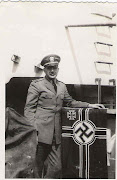
Standing on the brige of a German Sub captured by Commander Irvine's battle group.
Commander Irvine was awarded the Legion of Merit with the Combat V for his part in the destruction of another German Sub, U248, in January 1945

Tuesday, February 05, 2008

Verse of the day

Your attitude should be the same as that of Christ Jesus: Who, being in very nature God, did not consider equality with God something to be grasped...


Philippians 2:5-6, New International Version

Apple To Double Production of IPhone & IPod Touch

CUPERTINO, Calif. — Apple Inc. updated its iPhone and iPod Touch lineup Tuesday, doubling the memory and setting a new premium price for its high-end models.
The latest iPhone features 16 gigabytes of memory and retails for $499. The previously released 8 GB version of the hybrid cell phone, multimedia player and wireless Internet device costs $399.
The new iPod Touch comes with 32 GB of memory and retails for $499.

Mass Grave Discovered Near Baghdad

BAGHDAD (AP) - About 50 dead bodies were discovered Tuesday in a mass grave northwest of Baghdad, Iraqi officials said.
U.S.-backed Sunni tribesmen found the grave while patrolling the village of Jazeerah, 15 miles west of Samarra near Lake Tharthar, said Col. Mazin Younis Hussein, commander of the Samarra support force, a group of local men working with U.S. forces.

Iranian Landmines in Afghanistan

Afghan troops raided the house of a Taliban commander near the Iranian border, and seized over a hundred land mines. These appeared to have been manufactured in Iran. When the Afghans complained to Iran, they were told that Iran is not supplying the Taliban with weapons. That may be true, especially if you consider that the Iranian government is run by a group of senior clerics, who don't always agree with each other. The Iranian government is split into several factions, and each has a different agenda. The more radical factions can legally get landmines, and other weapons, from Iranian factories, and then do whatever they want with them. The more radical factions have gone as far as supplying Sunni Arab radicals in Iraq and Afghanistan with weapons, because the Iranians are so eager to kill U.S. troops. But these weapons are being given to groups that also kill Shia Moslems. Iran is mostly Shia, and is considered the protector of Shia Moslems everywhere. The Iranian government uses this as part of its defense in denying supplying the weapons to the Taliban (who killed thousands of Afghan Shia during the 1990s) and al Qaeda (which considers the Shia to be heretics.)

Michael Yon Has A New Post


The Men of Valor series derives from my second trip with the British Army in southern Iraq in 2007. The situation in the south has changed. Overall, the Iraq situation continues to improve, but there remain pockets of sharp fighting. I would tend to expect increased U.S. casualties during February and March. Al Qaeda, in particular, is increasingly being targeted in certain areas, including Mosul

Hero: Juan Ayala

A secure Iraq requires competent local police and national army. In Iraq, U.S. commanders have helped achieve stability in former hotbeds of violence by building up Iraqi Security Forces, thanks to the creative efforts of soldiers and Marines, such as Marine Corps Col. Juan Ayala.
During his third tour in Iraq, from January 2006 to January 2007, Col. Ayala served as the Senior Advisor to the 1st Iraqi Army Division, based at Camp Habbaniyah. Numerous challenges faced Ayala and his 29-man team, as they operated daily in tandem with the Iraqis. The Division lacked soldiers, trained officers and equipment. The surrounding terrain proved hostile as well. In early 2006, Anbar province remained volatile, and the Iraqi Army often found itself engaged in battles with civilians allied with insurgents.
Over time, under Ayala’s guidance, the Iraqis increased their areas of responsibility and gained credibility among the population. Specifically, Col. Ayala revamped the staff functions of the Division, drawing up missions that fit its skill set. He collaborated with local imams and sheiks to obtain approval for operations. As a result of the built-up trust, the flow of actionable intelligence to the Division increased, as did the number of formerly hostile Sunnis to the Division’s ranks. So many ended up joining the Iraqi forces that they eventually gained a title: the “sons of Al Anbar.”
Ayala helped plan and execute 52 direct action patrols in the area, which yielded 25 captured insurgents. Ayala’s input resulted in the creation of a 24-hour joint Iraqi/Advisor Combat Operations Center, which helped obtain situational awareness on the ground. Other positive developments under Ayala’s tenure included equipment improvements and the purging of hundreds of bogus soldiers from the Division’s ranks. Under Ayala, the implementation of a Unit Tracking Program (UTP) was influential in maintaining accountability among the Iraqi soldiers in the Division.
Ayala often went on patrols, serving as a vehicle and convoy commander. He was hit twice by IEDs, but kept going out on missions to assess the Division’s ability in the field. He led 17 teams and 225 advisors at different levels of command, to improve the capabilities of the Division. Today, two of the Division’s Brigades, the 3rd and the 4th, function without coalition assistance.
For his efforts in building up the 1st Iraqi Army Division, Col. Ayala earned the Legion of Merit with Combat Distinguishing Device.

Saturday, January 12, 2008


Human Events Endorses Fred


Posted on January 11th, 2008By Austin Walne in Conservative, Announcements
“Human Events Endorses Fred Thompson”The EditorsHuman EventsJanuary 11, 2008http://www.humanevents.com/article.php?id=24398

We begin by recalling the profound words of Ronald Reagan at the Conservative Political Action Conference Feb. 15, 1975: “A political party cannot be all things to all people. It must represent certain fundamental beliefs which must not be compromis ed to political expediency or simply to swell its numbers.” We believed that then, and we believe it now. The issue for us — and for the conservative community — boils down to which of the candidates is most representative of the fundamental conservative principles we believe in. The answer is Fred Thompson.

We conclude that Thompson is a solid conservative whose judgment is grounded in our principles.
In his Senate years, Mr. Thompson compiled an American Conservative Union lifetime rating of 86.1, which is higher than both Sen. John McCain (82.3) and Rep. Ron Paul (82.3). The Club for Growth has praised Thompson as someone who has a strong commitment to limited government, free enterprise and federalist principles.
On the issues that matter most to conservatives, Sen. Thompson’s positions benefit from their clarity. He is solidly pro-life. He sai d that he was in favor overturning Roe v. Wade because it was “bad law and bad medical science.” As the National Right to Life Committee said in its endorsement of him Nov. 13, 2007, “The majority of this country is opposed to the vast majority of abortions, and Fred Thompson has shown in his consistent pro-life voting record in the U.S. Senate that he is part of the pro-life majority.”
Thompson’s record is solid on voting to preserve gun owners’ rights, cut taxes, reduce government spending and drill for oil in Alaska’s Arctic National Wildlife Refuge. He has voted consistently against gay marriage.

We like the way Thompson unhesitatingly attacks the liberal ideologues and their activists such as MoveOn.org and the ACLU, and the way he reaches out to those we knew as the Reagan Democrats.
The question now is whether Sen. Thompson will do what he has not yet done: Take the advantages he is given by his intelligence, his principles, his polit ical skills and this endorsement and make the best use of them.
As the primaries and debates speed by, we would like to see Sen. Thompson continue to invigorate his campaign to carry him successfully through Tsunami Tuesday and to nomination at the Republican convention.
Sen. Thompson, you suffer, like most conservatives, from the built-in problem of not being a professional politician. It’s precisely as Rush Limbaugh said of you: “The problem with Thompson is, and a little bit with me, is I’m a depth guy. I like depth. Television doesn’t reward depth. Television rewards zingers, one-liners, cutesyisms. Fred Thompson produced a brilliant 17-minute video that was on YouTube that explains everything about every issue that he cares about. It’s clear he’s thought deeply about a whole lot.”

For example, your stand on reforming th e entitlement programs that threaten to bankrupt our nation is courageous and workable.

We agree with Rush Limbaugh’s characterization of your December 30 video speech to Iowa voters. More speeches like that one and an ad campaign demonstrating the Reaganesque inspiring optimism we know you have could create a momentum in South Carolina that would carry far beyond its borders.

A Combative Thompson Sways Voters

By PAUL VITELLO
Published: January 12, 2008
MYRTLE BEACH, S.C. — John and Ann Berenberk dutifully watched the umpteenth Republican presidential debate on television on Thursday night and had an epiphany. It was about the candidate they had previously referred to as the tall, silent one. Fred D. Thompson.

Operation Phantom Phoenix, Operation Marne Thunderbolt, Operation Iron Harvest

Operation Phantom Phoenix, Operation Marne Thunderbolt, Operation Iron Harvest
By Michelle Malkin • January 12, 2008 02:05 PM
Operation Phantom Phoenix, Operation Marne Thunderbolt, Operation Iron Harvest. Haven’t heard of them?
Bill Roggio spotlights our unsung heroes–American troops at work with Coalition and Iraqi security forces, ridding the world of al Qaeda jihadists.
Bill links this video of the Operation Marne Thunderbolt airstrike:

So it begins...

Well, Sniper school has finally begun. It is safe to say that it did not start out on the right foot. My unit was told that the guys going only had to check in with the duty officer at the School of Infantry on Thursday night, and that in-processing did not begin until Friday morning.

VICTORY!... In Kuwait Bush Claims Surge a Huge Success!

VICTORY!... In Kuwait Bush Claims Surge a Huge Success! (Video)
"History will say, it was when you were called upon, you served, and the service you rendered was absolutely necessary to defeat an enemy overseas so we do not have to face them here at home..."
President George W. Bush

Friday, December 28, 2007

Michael Yon: News flash for Osama bin Laden

Here’s a news flash for Osama bin Laden, who earlier today released a call “ to guerrilla forces in Mesopotamia.
I have directly observed how more and more Iraqis have grown to hate al Qaeda as much as Americans do. Al Qaeda has lost all credibility there, both from a religious standpoint as well as strategically. Even Western media seems to be gradually awakening to the realization that al Qaeda press releases on the topic of Iraq are about as well-informed as the post-invasion rantings of Baghdad Bob.

Fred Just Needs $20k More For Iowa Ad

Pakistan implicates Baitullah Mehsud in Bhutto assassination

By Bill Roggio
December 28, 2007 3:54 PM
The Pakistani government has directly implicated the commander of newly created Movement of the Taliban in Pakistan, or Tehrik-i-Taliban Pakistan. Interior Ministry spokesman Javed Iqbal Cheema claimed the government intercepted a phone conversation between none other than Baitullah Mehsud, the leader of the Pakistani Taliban, and Maulvi Sahib, one of Mehsud's underlings.
The Telegraph has the transcript of the alleged recording. Baitullah congratulates Sahib, who explains the attack was carried out by three of their own operatives.

Baghdad calm one year after Saddam's death

The latest breakthrough is the revival of Baghdad’s most prominent computer arcade.
Prominent refugees have returned from exile.
Restaurant owner Hamid Ilsan took his celebrated al-Rabiyah restaurant to Damascus three years ago but is now putting the finishing touches to a re-launch back in Baghdad.
“You can feel it,” he said. “It’s better than it has been for a long time. There’s 12 checkpoints on this street and lots of traffic jams. Customers are piling up out front.”
Read the whole thing

It Ain't Gonna Happen -SP

It Ain't Gonna Happen
December 28, 2007: Al Qaeda and the Sunni Arab terrorist organizations are in very bad shape. The momentum, gained by the start of the surge offensive earlier this year, has continued, and now the senior leadership of al Qaeda is getting killed or captured faster than the terrorist organization can find and appoint replacements. This is reflected in the greatly reduced number of attacks. U.S. casualties for December are the lowest American forces have ever suffered since the 2003 invasion. Iraqi police and army losses are down as well, but not as much. Iraqi security forces are doing more of the fighting. But there's another fight brewing between the new anti-terrorist Sunni Arab militias the Americans have established. The Shia dominated government sees these guys as Saddam's henchmen and previously terrorists themselves. That's accurate in many cases, but by getting these thugs to switch sides, the death rate in Iraq has plummeted. In fact, al Qaeda has called on its remaining followers to concentrate on the Sunni Arabs now working for the government. However, the Shia Arabs know that, long term, the Sunni Arab minority expects to regain power. To counter that, some Shia Arab militias are again attacking Sunni civilians and gunmen. The government is reluctant to deal with this, but U.S. troops are not, and now there's a lot of American raids on Shia militias, including some being trained by Iranian agents.

It's going to take generations before the Kurds and Shia forget the atrocities inflicted on them by the Sunni Arabs. Don't expect a resolution on that score any time soon. It ain't gonna happen.

Meanwhile, up north, Turkish warplanes have flown hundreds of sorties against PKK targets on the Iraqi side of the bomber. Hundreds of Turkish troops have then crossed into Iraq to search the area where the bombs fell. The Turks are looking for PKK terrorists, dead or alive, as well as documents and other evidence of PKK activity. The U.S. and Iraq are asking the Turks to use restraint, and the end result appears to be letting the Turks do what they want, as long as their targets (PKK camps and villages that have tolerated the Kurdish separatists) are indeed PKK related. The Turks consider this operation long overdue, and since it's Winter, it probably won't go on for long.

Pelosi Promises - Hot Air

House Speaker Nancy Pelosi has been in that role for nearly a year now, as the Democrat Congress itself nears the end of its first full year since taking over from the Republicans. On election night 2006 Pelosi made a few promises to the country during her victory speech. Hot Air TV takes a look at those promises and whether the Speaker fulfilled them.

Report: Islamic State of Iraq defense minister captured

By Bill RoggioDecember 27, 2007 6:09 PM

Banner of the Islamic State of Iraq. Click to view.
The Iraqi Army claimed to have captured the minister of defense of the Islamic State of Iraq, al Qaeda’s political front organization. Ahmed Turki Abbas was captured after being wounded in a skirmish near Mahmudiyah and “claimed the rank of defense minister,” Qassim al Moussawi, Iraq's military spokesman told Reuters.

Marco Martinez


In the spring of 2003, the 1st Marine Division drove north toward Baghdad – the tip of the spear that would lead the American assault against Saddam Hussein’s elite Fedayeen and Republican Guard throughout central Iraq. It was no easy road. Then-Cpl. Martinez’s actions during the battle of Tarmiya dealt the regime’s forces a serious blow – so much so that he was awarded the Navy Cross, the second-highest decoration in the United States armed forces.
On April 12, 2003, Martinez, serving with the 2nd Battalion, 5th Marine Regiment, 1st Marine Division, responded to a call to reinforce a platoon that had been ambushed. Under fire, Martinez moved his team into supporting positions to assault the enemy force. He eliminated two hostile fighters on the initial attack after his squad leader was wounded by a grenade blast. Martinez took control and led the assault into the area where the ambush had originated. Martinez and his outnumbered men moved through and cleared a nearby building occupied by enemy fighters. As they entered another compound they took stronger small-arms fire from the hostile forces inside. Martinez and his men fought their way through the building and into a courtyard, where the Fedayeen continued to engage the Marines from a garden shed.
Martinez saw that the enemy left a rocket propelled grenade launcher and two rounds on the ground on their way to the bunker. As his team provided cover fire, Martinez ventured into the open and grabbed the RPG launcher and sprinted behind a palm tree. After enemy fire wounded a member of his team, Martinez fired an RPG, 15 yards from the shed. The hostile forces continued targeting Martinez – but his assault had allowed his men to safely evacuate the wounded Marine. While the rest of the team took care of the injured man, Martinez single-handedly attacked the bunker. Dodging bullets, he ran up to the shed and lobbed a grenade into the building, killing four enemy forces and ending the firefight.
Deputy Secretary of Defense Gordon England presented Martinez with the Navy Cross in May 2004. The first Hispanic-American to receive the Navy Cross since the Vietnam War, Martinez repeatedly credits the Marine Corps for turning his life around. Having been a member of a gang for several years as a teenager, Martinez became drawn to the Marines after an encounter with a recruiter as a high-school senior. Today, Martinez emphatically states that “All I ever am, or will become, I owe to my beloved Corps.”

John Adams

"Fear is the foundation of most governments; but it is so
sordid and brutal a passion, and renders men in whose breasts it
predominates so stupid and miserable, that Americans will not be
likely to approve of any political institution which is founded
on it."
-- John Adams (Thoughts on Government, 1776)

Genesis 1:1-10

In the beginning You created the heavens and the earth. When the earth was formless and empty, and darkness was over the surface of the deep, Your Spirit hovered over the face of the waters. And You said, "Let there be light," and there was light. Then You said, "Let there be an expanse in the midst of the waters, and let it separate the waters from the waters." So You made the expanse and separated the waters under the expanse from the waters above it, and it was so. Then You said, "Let the waters under the heavens be gathered into one place, and let dry ground appear"; and it was so. And You saw that it was good. (Genesis 1:1-10)

Thursday, December 27, 2007

US military beefs up Pakistan force

By Bruce Loudon

US Special Forces are to increase their presence in Pakistan amid assessments that the country is to become the central battlefield for al-Qaida as it is driven from Iraq.
"Pakistan should be carefully watched because it could prove to be a significant flashpoint in the coming year," US think tank Strategic Forecasting said in an evaluation of al-Qaida's tactics as the Islamist group comes under mounting pressure in Iraq.
With the "rapid spread of Talibanisation" in Pakistan's insurgent northwest, the country would become "especially important if the trend in Iraq continues to go against the jihadis and they are driven from Iraq", the assessment said.

Another TB/homeland Security Debacle - Michele Malkin

Sweet


Product Features
1080/24P scanning with 2:3 pull-down recording
3 ClearVid CMOS sensor system; 4:2:2 color used by Sony Enhanced Image Processor
20x Carl Zeiss Vario-Zonnar T lens with extra-low dispersion glass; 1.5x digital extender
3.5-inch widescreen Clear Photo plus LCD display
Dual XLR audio inputs with variable control; supplied shotgun microphone
Technical Details
Lens: Carl Zeiss Vario-Sonnar T zoom lens; 20x optical zoom
Focal length: 3.9 to 78 millimeters; f = 37.4 to 748 millimeters (16:9 mode); f = 45.7 to 914 millimeters (4:3 mode); F = 1.6 to 2.8, filter diameter: 62 millimeters
Built-in filter: 1/4 ND, 1/16 ND
Imaging system: 1/4-inch, 3 ClearVid CMOS Sensor system
Picture elements: Approximately 1,037K pixels (effective), approximately 1,120K pixels (total)
White balance: Auto, one-push auto (2 positions), indoor (3200 K), outdoor (5800 K +15 steps, approximately 500K per step)
Manual shutter speed: 1/4, 1/8, 1/15, 1/30, 1/60, 1/90, 1/100, 1/125, 1/180, 1/250, 1/350, 1/500, 1/725, 1/1000, 1/1500, 1/2000, 1/3000, 1/4000, 1/6000, 1/10000 seconds
Manual shutter speed (24p scan): 1/3, 1/6, 1/12, 1/24, 1/40, 1/48, 1/50, 1/60, 1/96, 1/100, 1/120, 1/144, 1/192, 1/200, 1/288, 1/400, 1/576, 1/1200, 1/2400, 1/4800, 1/10000 seconds
Exposure: Auto, manual (Type1/Type2)
Gain: 0, 3, 6, 9, 12, 15, 18 dB
Minimum illumination: 4 lx with F1.6 at 18 dB
Recording format: 1080/60i, 480/60i (NTSC)
Play out/Down-conversion format: 1080/60i, 480/60i (NTSC)
Tape speed (HDV/DV SP): Max. 18.812 mm/s with PHDVM-63DM cassette
Tape speed (DVCAM): Max. 28.218 mm/s with PHDVM-63DM cassette
Playback/Recording time (HDV/DV SP): Max. 63 min with PHDVM-63DM cassette
Playback/Recording time (DVCAM): Max. 41 min with PHDVM-63DM cassette
Fast forward/Rewind time: Approximately 1 min 45 sec with PHDVM-63DM cassette (at DC operation); Approximately 2 min 40 sec with PHDVM-63DM cassette (at battery operation)
Audio/Video output: A/V out jack, 10-pin connector; Composite video: 1 Vp-p, 75O unbalanced, sync negative; Y: 1 Vp-p, 75O unbalanced; C: 0.286 Vp-p (burst signal), 75O unbalanced; Audio: 461 mV input impedance more than 47 kO, output impedance less than 2.2 kO
Component video output: Component out jack; Y: 1 Vp-p (0.3 V, sync negative), 75O unbalanced; Pr/Pb (Cr/Cb): 700 mVp-p (75% color bar)
HDV/DV input/output: i.LINK interface (IEEE 1394, 4-pin connector S100)
XLR audio input: XLR 3-pin female x 2, 461 mV, -60 dBu: 3 kO, +4 dBu: 10 kO, power supply: approx. 48 V
Headphones: Stereo mini jack (3.5 mm diameter)
LANC: Stereo mini-mini jack (2.5 mm diameter)
USB: Mini-B connector
HDMI output: HDMI connector
LCD viewfinder: 0.44-inch type, approx. 252K dots, 16:9 aspect ratio
LCD monitor: 3.5-inch Clear Photo LCD plus; approximately 211K dots, hybrid type, 16:9 aspect ratio
Speaker: 16mm dia.
Weight: Approx. 3 lb 6 oz (1.5 kg) (camcorder only)
Supplied accessories: AC-L15 AC adaptor, power cord. NP-F570 infoLITHIUM rechargeable battery pack, A/V connecting cable, Component connecting video cable, USB cable, lens hood with lens cover, large eyecup, RMT-831 wireless Remote Commander, ECM-NV1 monaural electolet condenser microphone, Operating instructions(CD-ROM), Printed operating instructions

Ron Paul: Dr. No (R-Texas) By: John Stossel

U.S. congressional representative and Republican presidential contender Ron Paul has been called "Dr. No" because he repeatedly votes against legislation he believes gives government too much power. If it's not in the Constitution, he says, the federal government has no business doing it. He even votes against appropriations to his constituents.

A Thorn in Putin's Side Named Oleg Kozlovsky

Meet Russian opposition leader Oleg Kozlovsky, who has “effectively held the Kremlin’s feet to the fire of democracy.” So much so that he has been “terrorized and silenced,” writes Kim Zigfeld.

Flower Power for Ron Paul

By Texas on the Potomac

Who would have imagined that Ron Paul, whose message is bare-bones government and who hails from a very red state, would be playing so well on the true blue west coast? But campaign finance reports show that the Lake Jackson Republican congressman is scooping up piles of cash from California, as well as Washington state, in his 2008 presidential campaign.
The Lone Star State just barely edged out California as the top venue for Paul's campaign contributions through September, the latest financial disclosure reports available.
Californians shelled out $724,174 for Paul compared to $725,215 from Texas, according to an analysis by CQ MoneyLine. Washington state, where Paul contributors gave $172,266, ranked as the candidate's fourth-highest source of money, behind Florida, where he received $302,791.
Paul raised almost as much money, $62,376, in that bastion of liberalism, San Francisco, as he did back home in more conservative Houston, where he received $66,632. Paul also received $34,619 from contributors in Los Angeles and $22,491 from supporters in Seattle.
While much of Paul's less government platform may not be in sync with west coast liberalism, his anti-war message does resonate there. And some of his libertarian stands, such as his support for decriminalizing illegal drugs, is also a hit with some in those parts.
Texans, meanwhile, aren't completely ignoring their home state candidate. Paul's top city for fund-raising was Dallas where he collected $108,933, followed by Austin, where contributors gave him $100,632. Hometown friends in Lake Jackson gave him $23,750.

Mark Steyn On Benazir Bhutto

Benazir Bhutto's return to Pakistan had a mad recklessness about it which give today's events a horrible inevitability. As I always say when I'm asked about her, she was my next-door neighbor for a while - which affects a kind of intimacy, though in fact I knew her only for sidewalk pleasantries. She was beautiful and charming and sophisticated and smart and modern, and everything we in the west would like a Muslim leader to be - though in practice, as Pakistan's Prime Minister, she was just another grubby wardheeler from one of the world's most corrupt political classes.

Senior al Qaeda leader killed in November raid - Bill Roggio

Multinational Forces Iraq has confirmed it killed a senior al Qaeda in Iraq commander during a raid near Samarra on November 8. The remains of Abu Abdullah, also known as Muhammad Sulayman Shunaythir al Zuba’i, have been positively identified by Multinational Forces Iraq.

Hindus, Christians Clash Again in India

NEW DELHI (AP) - Hindu extremists attacked village churches and burned down the home of a prominent Christian politician Thursday, officials said.

Pakistan's Bhutto killed in attack

Oldest WWI Vet Dies at 109

TOLEDO, Ohio - J. Russell Coffey, the oldest known surviving U.S. veteran of World War I, has died. The retired teacher, one of only three U.S. veterans from the "war to end all wars," was 109.
Coffey died Thursday at the Briar Hill Health Campus in North Baltimore, where he had lived for the past four or five years, said Gaye Boggs, nursing director at the nursing home. No cause of death has been determined, she said Friday. His health began failing in October.
"We're sure going to miss him," Boggs said. "He was our most famous resident, that's for sure."
More than 4.7 million Americans joined the military from 1917-1918. Coffey never saw combat because he was still in basic training when the war ended.
The two remaining U.S. veterans are Frank Buckles, 106, of Charles Town, W.Va.; and Harry Richard Landis, 108, of Sun City Center, Fla., according to the Veterans Affairs Department. In addition, John Babcock, 107, of Spokane, Wash., served in the Canadian army and is the last known Canadian veteran of the war.
Interest in World War I survivors grew over the past year as their numbers dwindled. The last living links to the war, the U.S. veterans received honors and did a flurry of interviews. In May, Buckles was a grand marshal of the National Memorial Day Parade in Washington, D.C., riding in the back of a car.
But Coffey once confided to his daughter, Betty Jo Larsen, that he wished people would remember his contributions rather than his old age. "He told me 'even a prune can get old,'" she said last spring. She died in September.
Coffey had enlisted in the Army while he was a student at Ohio State University in October 1918, a month before the Allied powers and Germany signed a cease-fire agreement. He was discharged a month after the war ended.
His two older brothers fought overseas, and he was disappointed at the time that the war ended before he shipped out. But he told The Associated Press in April 2007: "I think I was good to get out of it."
Born Sept. 1, 1898, Coffey played semipro baseball in Akron, earned a doctorate in education from New York University, taught in high school and college and raised a family.
He delivered newspapers as a youngster and would read the paper to immigrants, his daughter said. "That was the beginning of him being a teacher," she said.
Coffey returned to Ohio State University after he left the Army and received two degrees there.
He said he loved teaching. "I could see results," he said. "I could see improvement."
He taught junior high and high school in Phelps, Ky., and Findlay. He then taught physical education at Bowling Green State University from 1948 until 1969.
He had a remarkable memory and was independent, his daughter said. He drove his car until he was 104, and lived in his own home until a year later. He was a swimmer and credited healthy eating and exercise for his longevity.
His wife, Bernice, whom he married in 1921, died in 1993. Larsen was their only child.
Among the other World War I veterans who died this year were Emiliano Mercado del Toro, 115, who ranked as world's oldest person for the last weeks of his life, and Charlotte Winters, 109, the last known American female veteran of the war.

Todays Hero Justin Lewis Clough


The unconventional nature of the war in Iraq has demanded much from the Marine Corps NCOs on the ground. During his two tours in Iraq, Marine Corps Sgt. Justin L. Clough exhibited leadership on numerous occasions, in combat, communications, air support, and rescue missions. Clough served a Squad Leader with the 2nd Battalion, 8th Marine Regiment, and his squad undertook more than 100 combat patrols. In between missions, Clough trained his squad to enhance its communication skills with aircrews that provide support during combat operations. He also taught his team how to conduct evacuations for the wounded, and implemented cutting-edge infantry tactics. Clough’s dedication to training his men eventually helped save his life. Clough and his team repeatedly came under fire during direct and indirect attacks. They also had to constantly dodge improvised explosive devices (IEDs). Clough usually took the lead during assignments, constantly placing himself in the line of fire. On one occasion in Anbar province, an insurgent sniper wounded Clough. After quickly regaining consciousness, Clough’s first concern was to look out for the Marines next to him. Sgt. Nathaniel Clough, Justin’s twin brother, tended to his wounds.
Having been trained to deal with the situation at hand, Clough’s squad quickly and ably radioed in his injury, requested immediate assistance, and prepared an evacuation by air.
For his actions in combat, Sergeant Clough was honored with the USO (United Service Organizations) Marine of the Year award, as well as the Purple Heart. He has also been recommended for the Bronze Star with Combat “V” for valor. Clough’s service, which includes a tour of duty in Afghanistan, has been recognized by numerous institutions, including Stonington, CT, where the town celebrated “Justin Lewis Clough Day.” Clough threw out the first pitch at a Washington Nationals baseball game this past year.
Clough is quick to praise those around him – especially his brother, whom Clough credits with saving his life. Sgt. Nathaniel Clough later earned the Navy and Marine Corps Achievement Medal with a Combat “V.”

2 Corinthians 9:10

Now he who supplies seed to the sower and bread for food will
also supply and increase your store of seed and will enlarge the
harvest of your righteousness.
-- 2 Corinthians 9:10

Alexander Hamilton

"The circumstances that endanger the safety of nations are
infinite, and for this reason no constitutional shackles can wisely
be imposed on the power to which the care of it is committed. "
-- Alexander Hamilton (Federalist No. 23, 17 December 1787)