Friday, May 30, 2008


Thursday, May 29, 2008
Don’t blame Big Oil or Arabs for high gas prices
If any one entity should take the blame for high gas prices in the US, Mackubin Thomas Owens writes in today’s Wall Street Journal, it should be Congress.
Dude! Where's My Recession?
Economy's growth picks up in first quarter
WASHINGTON (AP) -- The economy plodded ahead at a 0.9 percent pace in the first quarter -- slightly better than first estimated
The new reading on gross domestic product, released by the Commerce Department on Thursday, was an improvement from the government's initial growth estimate for the January-to-March quarter as well as the economy's performance in the final quarter of last year. Both periods were pegged at a 0.6 percent growth rate.
Michael Murphy

For a U.S. Navy SEAL, dangerous situations in isolated, treacherous locations are just an average day on the job. This was the case for Lieutenant Michael Murphy, who entered the lonely mountain range of the Hindu Kush between Afghanistan and Pakistan on June 28, 2005. Leading a four-man SEAL element – which included Petty Officers Danny Dietz, Matthew Axelson, and Marcus Luttrell – Murphy and his team were tasked with tracking down Ahmad Shah, a known terrorist.
As the team crept through the rugged terrain, three goat herders came upon the SEALs. Just hours after releasing the local nationals, a large enemy force came pouring over the mountains.
A fierce gun battle ensued between the severely outnumbered SEALs and the larger Taliban force. Murphy realized that his team would not last long without reinforcements, so despite his injuries, he moved away from the rocks that were sheltering him to make radio contact with Bagram Air Base. Without the protection of the terrain, Murphy was a prime target for incoming Taliban gunfire.
As bullets riddled his body, Murphy held on long enough to make contact with the Special Operations Forces Quick Reaction Force at headquarters.
Murphy made his way back to his unit, severely wounded, and continued to fight alongside his comrades. The fighting continued for two hours leaving three out of the four SEALs mortally wounded. The Chinook helicopter that responded to Murphy’s call was shot down by the enemy, killing all 16 men aboard.
Luttrell, severely wounded, traveled seven miles to a nearby Afghan village where he was taken in and sheltered from the Taliban. One villager reported Luttrell’s location to a Marine outpost and U.S. forces launched a rescue mission on July 2 that brought him home. The lone survivor of Operation Red Wing was later awarded the Navy Cross. His comrades, Dietz and Axelson, were posthumously awarded Navy Crosses for their heroic actions.
Murphy’s selfless act was honored by President Bush on October 22, 2007, when Murphy was posthumously awarded the Medal of Honor, making him the first Navy Medal of Honor recipient for actions in the Global War on Terror, and the first to be awarded for actions in Operation Enduring Freedom. On May 7, 2008, Secretary of the Navy Donald Winter announced that the newest guided-missile destroyer will be named in honor of Lt. Michael Murphy
As the team crept through the rugged terrain, three goat herders came upon the SEALs. Just hours after releasing the local nationals, a large enemy force came pouring over the mountains.
A fierce gun battle ensued between the severely outnumbered SEALs and the larger Taliban force. Murphy realized that his team would not last long without reinforcements, so despite his injuries, he moved away from the rocks that were sheltering him to make radio contact with Bagram Air Base. Without the protection of the terrain, Murphy was a prime target for incoming Taliban gunfire.
As bullets riddled his body, Murphy held on long enough to make contact with the Special Operations Forces Quick Reaction Force at headquarters.
Murphy made his way back to his unit, severely wounded, and continued to fight alongside his comrades. The fighting continued for two hours leaving three out of the four SEALs mortally wounded. The Chinook helicopter that responded to Murphy’s call was shot down by the enemy, killing all 16 men aboard.
Luttrell, severely wounded, traveled seven miles to a nearby Afghan village where he was taken in and sheltered from the Taliban. One villager reported Luttrell’s location to a Marine outpost and U.S. forces launched a rescue mission on July 2 that brought him home. The lone survivor of Operation Red Wing was later awarded the Navy Cross. His comrades, Dietz and Axelson, were posthumously awarded Navy Crosses for their heroic actions.
Murphy’s selfless act was honored by President Bush on October 22, 2007, when Murphy was posthumously awarded the Medal of Honor, making him the first Navy Medal of Honor recipient for actions in the Global War on Terror, and the first to be awarded for actions in Operation Enduring Freedom. On May 7, 2008, Secretary of the Navy Donald Winter announced that the newest guided-missile destroyer will be named in honor of Lt. Michael Murphy
Tuesday, May 27, 2008
Sniper Jake Has A Request

We could use-
jerky
sunflower seeds
gum
drink mixes
AAA/AA batteries
old books/magazines
protein powder packets (individual packets)
copenhagen (not for me)
crossword/word game books
boot socks.
Cpl Wood, J2/7 H&S Co., SSPUnit 41545FPO AE 96426-1545
Al Qaeda Discusses Losing Iraq
Al Qaeda web sites are making a lot of noise about "why we lost in Iraq."
Dude! Where's My Recession?
US new home sales rose unexpectedly in April
Sales of new homes across the United States rose an unexpected 3.3 percent in April from the prior month, to a seasonally adjusted annual pace of 526,000 homes, a government report showed Tuesday.
The spike in sales confounded most economists forecasts of a sales decline last month.
The spike in sales confounded most economists forecasts of a sales decline last month.

Iraqis losing patience with militiamen
BAGHDAD -- Four summers ago, when militiamen loyal to hard-line Shiite Muslim cleric Muqtada Sadr were battling U.S. forces in the holy city of Najaf, Mohammed Lami was among them. "I had faith. I believed in something," Lami said of his days hoisting a gun for Sadr's Mahdi Army militia. "Now, I will never fight with them."Lami is no fan of U.S. troops, but after fleeing Baghdad's Sadr City district with his family last month, when militiamen arrived on his street to plant a bomb, he is no fan of the Mahdi Army either. Nor are many others living in Sadr City, the 32-year-old said. Weeks of fighting between militiamen and Iraqi and U.S. forces, with residents caught in the middle, has chipped away at the Sadr movement's grass-roots popularity, Lami said.
An American Hero: Sheffield F. Ford III

The Story:
The 23rd and 24th of June 2006 would be a crucible of leadership and heroism for an already battle-tested and decorated captain in the U.S. Army’s Special Forces. Captain Sheffield F. Ford III was in charge of some 16 Americans and 46 Afghan Army soldiers during "Operation Kaika" in the Panjawi District of Afghanistan’s Kandahar province. In the bleak farmland, criss-crossed by ditches and barren expanses, Ford led his unit to "re-establish order" in the contested region, entering a Spartan Afghan village on the 23rd. The dilapidated buildings and mud huts were hiding a Taliban force of unknown strength with one thought on their minds: killing Americans and the Afghan soldiers working to take back their country. In their hastily prepared patrol base, Ford organized a perimeter as night enveloped the isolated Special Forces team and their Afghan allies.
As darkness fell, "all hell [broke] loose." From three directions, rifle, machine gun, and rocket-propelled grenade fire landed and exploded on their position. One of Ford’s squad mates later said they had "not seen this disciplined execution of infantry tactics" by the Taliban. Ford dug his men in to repel the assault.
Moving from position to position, he alternated between barking orders, firing at the enemy, and rallying the Afghan soldiers with him. As the night crept on, the remaining Taliban fighters withdrew and Ford took stock of the situation.
Early the next day, he ordered some of his Special Forces operators to lead a team of Afghans into the suspected Taliban hideout. As the unit engaged the hostiles, it was divided in two when some 200 Taliban fighters poured out, separating the American attackers and surrounding the make-shift patrol base.
Over the radio, Ford was connected with one of the translators who had been leading the mission on the Taliban position. The translator saw two Americans were fighting despite being severely wounded and feared capture at any minute. Knowing the ramifications of being taken alive by the Taliban, the translator told Ford he would, if ordered, end the suffering of the troops and his own life rather than be captured. Ford responded, "We’ve got people coming." Ford organized and launched an effective rescue to recover the translator and wounded troops, even if they were mortally wounded. He would not allow American or Afghan alike to be taken in any condition by the Taliban.
The adversaries fought so close to one another that the terrorists screamed to the Afghan soldiers that, "we can forgive you; just put your weapons down and walk away. We want the Americans alive." The months of training and the ties formed between the Americans and the Afghans were put to the test. Seeing the example of Ford running to each of the beleaguered fighters in the face of constant fire, and remembering all they had endured alongside their American trainers, the Afghan soldiers responded to the Taliban’s offer with well-aimed shots and an unbreakable defense.
Exemplifying the U.S. Special Forces motto, De Opresso Liber (to liberate the oppressed), Ford inspired his Afghan troops to stand up to the Taliban fighters and bring them down. He led an evacuation of all the men under his command, wounded included, out of the village under the cover of Apache attack choppers to ensure all would be safe, while sealing the fate of the insurgents. Ford successfully extricated his men, and the unit had more than 120 confirmed kills. Just as the Americans and Afghans had trained together, they sacrificed together; two American and three Afghan soldiers would not leave the battlefield alive. For his accomplishments in the face of such an overpowering force, Ford was awarded the Silver Star, the nation’s third highest military award.
The 23rd and 24th of June 2006 would be a crucible of leadership and heroism for an already battle-tested and decorated captain in the U.S. Army’s Special Forces. Captain Sheffield F. Ford III was in charge of some 16 Americans and 46 Afghan Army soldiers during "Operation Kaika" in the Panjawi District of Afghanistan’s Kandahar province. In the bleak farmland, criss-crossed by ditches and barren expanses, Ford led his unit to "re-establish order" in the contested region, entering a Spartan Afghan village on the 23rd. The dilapidated buildings and mud huts were hiding a Taliban force of unknown strength with one thought on their minds: killing Americans and the Afghan soldiers working to take back their country. In their hastily prepared patrol base, Ford organized a perimeter as night enveloped the isolated Special Forces team and their Afghan allies.
As darkness fell, "all hell [broke] loose." From three directions, rifle, machine gun, and rocket-propelled grenade fire landed and exploded on their position. One of Ford’s squad mates later said they had "not seen this disciplined execution of infantry tactics" by the Taliban. Ford dug his men in to repel the assault.
Moving from position to position, he alternated between barking orders, firing at the enemy, and rallying the Afghan soldiers with him. As the night crept on, the remaining Taliban fighters withdrew and Ford took stock of the situation.
Early the next day, he ordered some of his Special Forces operators to lead a team of Afghans into the suspected Taliban hideout. As the unit engaged the hostiles, it was divided in two when some 200 Taliban fighters poured out, separating the American attackers and surrounding the make-shift patrol base.
Over the radio, Ford was connected with one of the translators who had been leading the mission on the Taliban position. The translator saw two Americans were fighting despite being severely wounded and feared capture at any minute. Knowing the ramifications of being taken alive by the Taliban, the translator told Ford he would, if ordered, end the suffering of the troops and his own life rather than be captured. Ford responded, "We’ve got people coming." Ford organized and launched an effective rescue to recover the translator and wounded troops, even if they were mortally wounded. He would not allow American or Afghan alike to be taken in any condition by the Taliban.
The adversaries fought so close to one another that the terrorists screamed to the Afghan soldiers that, "we can forgive you; just put your weapons down and walk away. We want the Americans alive." The months of training and the ties formed between the Americans and the Afghans were put to the test. Seeing the example of Ford running to each of the beleaguered fighters in the face of constant fire, and remembering all they had endured alongside their American trainers, the Afghan soldiers responded to the Taliban’s offer with well-aimed shots and an unbreakable defense.
Exemplifying the U.S. Special Forces motto, De Opresso Liber (to liberate the oppressed), Ford inspired his Afghan troops to stand up to the Taliban fighters and bring them down. He led an evacuation of all the men under his command, wounded included, out of the village under the cover of Apache attack choppers to ensure all would be safe, while sealing the fate of the insurgents. Ford successfully extricated his men, and the unit had more than 120 confirmed kills. Just as the Americans and Afghans had trained together, they sacrificed together; two American and three Afghan soldiers would not leave the battlefield alive. For his accomplishments in the face of such an overpowering force, Ford was awarded the Silver Star, the nation’s third highest military award.
Remembering
It is important to remember the sacrifice of so many Americans who made the ultimate sacrifice for us. We at the Combined Arms Center and Fort Leavenworth are fortunate to call Kansas home and therefore, we would like to highlight the service and sacrifice of one native Kansan in order to share the incredible commitment and sacrifice of all our troops and their Families.
First Sergeant Timothy Millsap of Wichita, Kansas epitomized the word duty. He was in his twentieth year of service when he was alerted to deploy to Iraq for the second time. He could have hung it up at twenty and retired to a life of rest and relaxation, but that wasn’t Tim’s way. It simply wasn’t his nature. He was a born leader and leading Soldiers is where he always wanted to be. On April 25, 2005 he was killed by an IED near Baghdad. Tim gave his life for his Soldiers and his country. He is one of the many thousands of reasons we observe Memorial Day.
However, Memorial Day isn’t just about the Soldiers who have sacrificed. It is also about the ones who are currently serving and sacrificing. This Memorial Day while you are spending time with family and enjoying a great barbeque outing, remember that we have Soldiers in harms way protecting your way of life and other people’s freedom.
Finally, this Memorial Day should also be about our “Gold Star” Families who have sacrificed too. You see, Tim had a Mom, Rosie, and a Dad, Kenny, who fell to the floor in sorrow when three uniformed service members came to their door one day. Tim had a wife of 20 years, Alyne, and a fifteen year old daughter, Deanna. There is a Daughter today who doesn’t have her father to take her hunting, to see her off to her prom or snap a million pictures at her graduation. When a woman named Lydia Bixby lost five sons in the Civil War, President Abraham Lincoln eloquently wrote that she had “laid so costly a sacrifice at the altar of freedom.” This Memorial Day, let’s remember our fallen heroes, those currently serving and let’s not forget to thank the Rosie’s, the Kenny’s, the Alyne’s, the Deanna’s and the countless other Families who have laid their sacrifice at the altar of freedom…. Our freedom!
First Sergeant Timothy Millsap of Wichita, Kansas epitomized the word duty. He was in his twentieth year of service when he was alerted to deploy to Iraq for the second time. He could have hung it up at twenty and retired to a life of rest and relaxation, but that wasn’t Tim’s way. It simply wasn’t his nature. He was a born leader and leading Soldiers is where he always wanted to be. On April 25, 2005 he was killed by an IED near Baghdad. Tim gave his life for his Soldiers and his country. He is one of the many thousands of reasons we observe Memorial Day.
However, Memorial Day isn’t just about the Soldiers who have sacrificed. It is also about the ones who are currently serving and sacrificing. This Memorial Day while you are spending time with family and enjoying a great barbeque outing, remember that we have Soldiers in harms way protecting your way of life and other people’s freedom.
Finally, this Memorial Day should also be about our “Gold Star” Families who have sacrificed too. You see, Tim had a Mom, Rosie, and a Dad, Kenny, who fell to the floor in sorrow when three uniformed service members came to their door one day. Tim had a wife of 20 years, Alyne, and a fifteen year old daughter, Deanna. There is a Daughter today who doesn’t have her father to take her hunting, to see her off to her prom or snap a million pictures at her graduation. When a woman named Lydia Bixby lost five sons in the Civil War, President Abraham Lincoln eloquently wrote that she had “laid so costly a sacrifice at the altar of freedom.” This Memorial Day, let’s remember our fallen heroes, those currently serving and let’s not forget to thank the Rosie’s, the Kenny’s, the Alyne’s, the Deanna’s and the countless other Families who have laid their sacrifice at the altar of freedom…. Our freedom!
Monday, May 26, 2008
Memorial Day

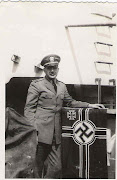
James McCabe Irvine Sr.
Standing on the brige of a German Sub captured by Commander Irvine's battle group.
Commander Irvine was awarded the Legion of Merit with the Combat V for his part in the destruction of another German Sub, U248, in January 1945
Tuesday, February 05, 2008
Verse of the day
Your attitude should be the same as that of Christ Jesus: Who, being in very nature God, did not consider equality with God something to be grasped...
Philippians 2:5-6, New International Version
Philippians 2:5-6, New International Version
Apple To Double Production of IPhone & IPod Touch
CUPERTINO, Calif. — Apple Inc. updated its iPhone and iPod Touch lineup Tuesday, doubling the memory and setting a new premium price for its high-end models.
The latest iPhone features 16 gigabytes of memory and retails for $499. The previously released 8 GB version of the hybrid cell phone, multimedia player and wireless Internet device costs $399.
The new iPod Touch comes with 32 GB of memory and retails for $499.
The latest iPhone features 16 gigabytes of memory and retails for $499. The previously released 8 GB version of the hybrid cell phone, multimedia player and wireless Internet device costs $399.
The new iPod Touch comes with 32 GB of memory and retails for $499.
Mass Grave Discovered Near Baghdad
BAGHDAD (AP) - About 50 dead bodies were discovered Tuesday in a mass grave northwest of Baghdad, Iraqi officials said.
U.S.-backed Sunni tribesmen found the grave while patrolling the village of Jazeerah, 15 miles west of Samarra near Lake Tharthar, said Col. Mazin Younis Hussein, commander of the Samarra support force, a group of local men working with U.S. forces.
U.S.-backed Sunni tribesmen found the grave while patrolling the village of Jazeerah, 15 miles west of Samarra near Lake Tharthar, said Col. Mazin Younis Hussein, commander of the Samarra support force, a group of local men working with U.S. forces.
Iranian Landmines in Afghanistan
Afghan troops raided the house of a Taliban commander near the Iranian border, and seized over a hundred land mines. These appeared to have been manufactured in Iran. When the Afghans complained to Iran, they were told that Iran is not supplying the Taliban with weapons. That may be true, especially if you consider that the Iranian government is run by a group of senior clerics, who don't always agree with each other. The Iranian government is split into several factions, and each has a different agenda. The more radical factions can legally get landmines, and other weapons, from Iranian factories, and then do whatever they want with them. The more radical factions have gone as far as supplying Sunni Arab radicals in Iraq and Afghanistan with weapons, because the Iranians are so eager to kill U.S. troops. But these weapons are being given to groups that also kill Shia Moslems. Iran is mostly Shia, and is considered the protector of Shia Moslems everywhere. The Iranian government uses this as part of its defense in denying supplying the weapons to the Taliban (who killed thousands of Afghan Shia during the 1990s) and al Qaeda (which considers the Shia to be heretics.)
Michael Yon Has A New Post

The Men of Valor series derives from my second trip with the British Army in southern Iraq in 2007. The situation in the south has changed. Overall, the Iraq situation continues to improve, but there remain pockets of sharp fighting. I would tend to expect increased U.S. casualties during February and March. Al Qaeda, in particular, is increasingly being targeted in certain areas, including Mosul
Hero: Juan Ayala
 A secure Iraq requires competent local police and national army. In Iraq, U.S. commanders have helped achieve stability in former hotbeds of violence by building up Iraqi Security Forces, thanks to the creative efforts of soldiers and Marines, such as Marine Corps Col. Juan Ayala.
During his third tour in Iraq, from January 2006 to January 2007, Col. Ayala served as the Senior Advisor to the 1st Iraqi Army Division, based at Camp Habbaniyah. Numerous challenges faced Ayala and his 29-man team, as they operated daily in tandem with the Iraqis. The Division lacked soldiers, trained officers and equipment. The surrounding terrain proved hostile as well. In early 2006, Anbar province remained volatile, and the Iraqi Army often found itself engaged in battles with civilians allied with insurgents.
Over time, under Ayala’s guidance, the Iraqis increased their areas of responsibility and gained credibility among the population. Specifically, Col. Ayala revamped the staff functions of the Division, drawing up missions that fit its skill set. He collaborated with local imams and sheiks to obtain approval for operations. As a result of the built-up trust, the flow of actionable intelligence to the Division increased, as did the number of formerly hostile Sunnis to the Division’s ranks. So many ended up joining the Iraqi forces that they eventually gained a title: the “sons of Al Anbar.”
Ayala helped plan and execute 52 direct action patrols in the area, which yielded 25 captured insurgents. Ayala’s input resulted in the creation of a 24-hour joint Iraqi/Advisor Combat Operations Center, which helped obtain situational awareness on the ground. Other positive developments under Ayala’s tenure included equipment improvements and the purging of hundreds of bogus soldiers from the Division’s ranks. Under Ayala, the implementation of a Unit Tracking Program (UTP) was influential in maintaining accountability among the Iraqi soldiers in the Division.
Ayala often went on patrols, serving as a vehicle and convoy commander. He was hit twice by IEDs, but kept going out on missions to assess the Division’s ability in the field. He led 17 teams and 225 advisors at different levels of command, to improve the capabilities of the Division. Today, two of the Division’s Brigades, the 3rd and the 4th, function without coalition assistance.
For his efforts in building up the 1st Iraqi Army Division, Col. Ayala earned the Legion of Merit with Combat Distinguishing Device.
Subscribe to:
Posts (Atom)